

A 90-day approach to steady energy for people who sit, think, and ship for a living.
By David Reveles, Founder of Origins Unity
Quick answer: Low energy at a desk job is rarely one broken thing. It is usually three or four systems running a little under capacity at the same time — sleep timing, blood sugar, movement, and stress load. Fix them in order rather than all at once: protect sleep first, stabilize meals second, add movement third, and train your stress response throughout. Most people feel a shift in two to three weeks.
Here is the version most people live.
You wake up tired. Not wrecked — just flat. Coffee carries you to about eleven. Lunch happens at your keyboard. By 2:30 you are rereading the same paragraph for the third time, so you get a second coffee and call it focus.
You get home. You are too wired to rest and too tired to train. You scroll. You eat something you did not really choose. You go to bed late, sleep seven hours on paper, and wake up flat again.
Nothing in that day is dramatic. That is exactly why it continues.
The common diagnosis is a character flaw. You need more discipline. You need to want it more. If you are reading this at 11pm on a Tuesday, you have probably already tried wanting it more.
Discipline is not the limiter. Capacity is. And capacity is built, not summoned.
Energy is not a single tank. It is the output of several systems working together, and each one can quietly run below capacity without anything showing up as a problem.
Your sleep can be long enough and still not be restorative. Your meals can be reasonable and still swing your blood sugar hard enough to produce an afternoon crash. You can be active on weekends and still spend fifty hours a week in a chair. Your stress response can stay switched on at 10pm even though the meeting ended at four.
Any one of those is survivable. Three at once is what “always tired” actually feels like.
Here is the part that matters for how you fix it: these systems feed each other. Short sleep makes you hungrier and makes hard training feel worse. A blood sugar crash makes you reach for caffeine, which pushes your bedtime later, which shortens sleep. Stress makes you skip the walk, and the missed walk makes the stress stick around.
So when people attack the problem with a single heroic intervention — a 5am bootcamp, a strict diet, a supplement stack — they are usually adding load to a system that is already over-loaded. It works for nine days. Then it does not.
The way out is sequencing. Reduce the load first. Then add the stimulus.
If you want the diagnostic side of this — the specific places fatigue tends to hide, including thyroid, iron, and inflammation — read Why Am I Always Tired? 8 Overlooked Places to Look First. This guide is the other half: what to actually do about it.
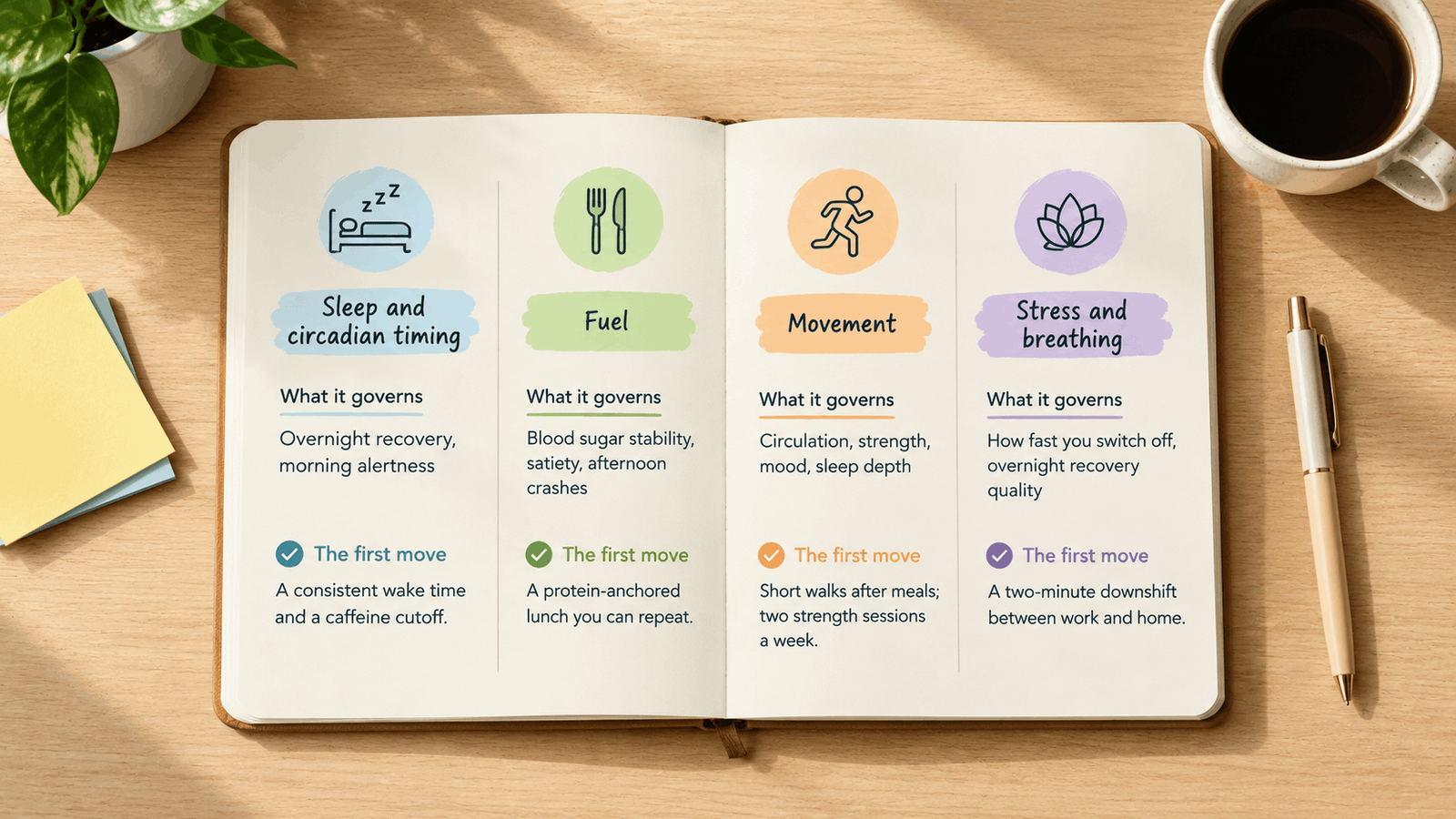
Almost everything that moves daytime energy for a desk worker sits in one of four places.
| Lever | What it governs | The first move |
|---|---|---|
| Sleep and circadian timing | Overnight recovery, morning alertness | A consistent wake time and a caffeine cutoff |
| Fuel | Blood sugar stability, satiety, afternoon crashes | A protein-anchored lunch you can repeat |
| Movement | Circulation, strength, mood, sleep depth | Short walks after meals; two strength sessions a week |
| Stress and breathing | How fast you switch off, overnight recovery quality | A two-minute downshift between work and home |
Notice what is not on that list: willpower, supplements, and 5am. Those are either downstream of the four levers or irrelevant to them.
Work them in order. Sleep first, because it multiplies everything else.
Most desk workers do not have a sleep problem. They have a bedtime problem and a timing problem.
The sleep research consensus is straightforward: the CDC lists seven or more hours a night for adults, matching the American Academy of Sleep Medicine and Sleep Research Society joint recommendation. That is a floor, not a target to shave.
But hours are only half of it. Timing is the other half, and timing is where knowledge workers lose.
Pick a wake time you can hold seven days a week, within about an hour. Your body clock takes its strongest cue from morning light and a consistent rise. Chasing bedtime while your wake time floats by two hours is like trying to fix a build by editing the output.
Ten minutes outside in the first hour after waking does more for your alertness curve than the first coffee does. Overcast counts. A window does not count for much — glass filters a lot of what you want.
This is the single highest-yield change for most people I work with. In a controlled study, 400 mg of caffeine taken six hours before bed still reduced measured total sleep time by more than an hour — and the participants largely did not notice. That is the trap. The 4pm coffee does not feel like it is costing you sleep, which is precisely why it keeps costing you sleep.
Try a hard stop eight hours before bed for two weeks. If you go to bed at 10:30, that is 2:30pm. Expect three rough afternoons, then a noticeably better morning.
The hour before sleep should get progressively dimmer and less demanding. Lights down. Work closed. If your brain starts producing tomorrow’s task list, write it down — the list is trying to make sure you do not forget it, and paper satisfies that.
You do not need a diet. You need meals that do not cause a crash.
The 2:30pm slump is often not a mystery. It is a large, carbohydrate-heavy, low-protein lunch eaten quickly at a desk, landing on top of a skipped or coffee-only breakfast.
Three changes cover most of it.
Anchor every meal with protein. Protein and fiber are what make a meal hold. If you are hungry ninety minutes after eating, the meal was short on one of them — not on willpower.
Build the plate visually instead of tracking it. Half the plate vegetables, a quarter protein, a quarter carbohydrate foods, with fat already present in the cooking or the protein. No app required. We teach this as the Clock Method — healthy eating without counting calories, and NIDDK’s portion guide is a useful reference for sizing without logging.
Repeat your meals. You do not need a new recipe every day. Two reliable lunches and three reliable dinners, with the ingredients actually in the house, will outperform an ambitious meal plan that assumes a free Sunday you do not have.
Carbohydrates are not the enemy here. Rice, potatoes, oats, and fruit all belong in a working person’s diet, and cutting them aggressively often makes training feel worse and sleep get shorter. The issue is usually a carbohydrate-only meal with nothing to slow it down.
If your goal includes body composition as well as energy, Sustainable Fat Loss: How Holistic Fitness Helps You Lose Weight and Keep It Off covers how the two fit together. If you are using a GLP-1 medication, this guide to protecting muscle, nutrition, and energy is the relevant one.
This is general nutrition education, not individualized medical nutrition therapy. Therapeutic diets belong with a registered dietitian or your physician.
The instinct when you are exhausted is to rest more. For most desk workers, the problem is the opposite: the body is under-stimulated and over-stressed at the same time.
The current Physical Activity Guidelines call for at least 150 minutes of moderate-intensity activity a week plus muscle-strengthening work on two or more days. That is the public health floor. For an energy problem specifically, the sequencing matters more than the total.
Start with walking, especially after meals. Ten minutes after lunch does more for your afternoon than almost anything else available to you. It blunts the post-meal slump, it gets you light, and it is small enough that it survives a bad week.
Break up the sitting. Something every hour. Stand, walk to fill water, two minutes of hip and thoracic work. Sixty uninterrupted minutes in a chair is a posture problem and a circulation problem at the same time.
Add two strength sessions a week before you add anything else. Not six. Two. Thirty to forty minutes, six to eight movements, taken a few repetitions short of failure. Strength work is the highest-return training a tired professional can do: it builds capacity, it protects the body against the chair, and the dose is small enough to sustain.
Keep intensity low while you are still under-recovered. This is counterintuitive and it is where most people get it wrong. If your sleep is short and your stress load is high, high-intensity training adds to the pile instead of relieving it. Earn the hard sessions. They will be available in six weeks.
For a short-session structure built around a real calendar, see fitness and nutrition plans for busy professionals with limited time.
The specific exhaustion of knowledge work is not muscular. It is the cost of staying switched on for nine hours and then not switching off.
You know the state. Tired body, busy head. Too drained to train, too activated to sleep.
Breathing is the most direct lever you have on that, because it is the one part of your stress physiology under voluntary control. You cannot decide to lower your heart rate. You can change how you breathe, and the rest follows.
The transition downshift. Two minutes between work and the rest of your evening. Sit. Breathe through your nose. Make the exhale longer than the inhale — four in, six out is a reasonable starting ratio. This is a downregulating practice; stop if you feel lightheaded, and keep the breath comfortable rather than deep.
Nasal breathing by default. During walks, during easy training, during the day. Mouth breathing at rest is a habit worth noticing and changing.
The pre-sleep version. Same long-exhale pattern, five minutes, lights low, lying down.
None of this is mystical and none of it requires an app. If you want to understand what your own breathing pattern looks like before choosing a practice, What Is a Breathing Assessment? walks through it. For the workplace side of stress load, Corporate Wellness Programs: 10 Ways to Reduce Workplace Stress and Burnout covers what organizations can change.
Order of operations is most of the method. Here is how we phase it inside Fatigue to Fit.
Anchor the wake time. Move the caffeine cutoff. Build two repeatable meals. Walk after lunch. Add the two-minute downshift. Train twice a week at an easy, boring intensity.
The goal of this month is not progress. It is removing friction so progress becomes possible. Most people report steadier mornings and fewer afternoon crashes somewhere in weeks two to three. That is the expected pattern, not a promise.
Now the body can absorb training. Strength work gets progressively harder. Conditioning comes back in. Meals get more deliberate — protein targets, better breakfasts, the cravings and caffeine patterns addressed directly rather than white-knuckled. Routines get built for the specific shape of your workday.
This phase is about what happens on bad weeks. Travel. A launch. A sick kid. Everything built in the first sixty days gets a minimum viable version that survives disruption. You build the decision rules yourself — what to cut first, what never gets cut — so you can run the system without a coach reminding you.
The point of ninety days is not ninety days. It is that you leave with something you can keep running.
Measure the things that move first.
Five numbers, thirty seconds a day. Review weekly, not daily — daily readings are mostly noise.
What not to lead with: the scale. Body composition moves later than energy does, and anchoring on it in month one tends to produce exactly the restrictive behavior that made you tired in the first place.
Some of the differences between people here are genuinely biological. Caffeine clearance varies. Chronotype varies. Recovery capacity and inflammatory tendency vary.
Our clients complete a genetic wellness assessment, and we use it as one input among several — alongside symptoms, history, labs, environment, and preference.
What that means in practice: genes describe tendencies, not outcomes. A variant associated with slower caffeine clearance is a reason to test an earlier cutoff, not a verdict. Genetics can sharpen a hypothesis and help you prioritize which lever to pull first. It does not replace the work, and no genetic report produces a transformation on its own.
We will not tell you your DNA reveals your perfect diet. It does not, and anyone selling that is overstating what the evidence supports.
This is the part that gets skipped and should not be.
Persistent or unexplained fatigue can be a sign of something that needs proper medical evaluation — thyroid dysfunction, anemia, sleep apnea, depression, and others. A coaching program is not a substitute for a diagnosis.
Please see a qualified healthcare provider if your fatigue is severe, came on suddenly, or comes with unintended weight loss, chest pain, shortness of breath, loud snoring with pauses in breathing, persistent low mood, or anything else that concerns you. If you are on medication, do not change it based on anything you read here.
Everything in this guide is general wellness education, not medical advice.
Do not run all four levers at once. Pick the two cheapest changes and hold them for seven days:
That is it. Log morning energy out of ten. See what the week tells you.
Small, repeatable, and boring is what works. It is also the hardest thing to sell, which is why most programs sell you something else.
Fatigue to Fit is a 90-day coaching program for professionals who are done guessing. We combine training, nutrition, sleep, breathing, and recovery into one personalized system — informed by your genetic profile, built around your calendar, and adjusted as you go.
Book a consult call and we will talk through where your energy is most likely leaking and what your first ninety days would look like. No pitch.
1. How long before I feel different?
Most people notice steadier mornings and a smaller afternoon dip within two to three weeks of holding a consistent wake time and an earlier caffeine cutoff. Training and body composition changes come later. These are typical patterns, not guarantees — your starting point matters.
2. I already sleep eight hours and I am still exhausted. Now what?
Then duration is not your limiter, and it is worth looking at quality and timing. Inconsistent wake times, late caffeine, late heavy meals, alcohol, and undiagnosed sleep apnea all produce long, unrestorative sleep. Loud snoring, witnessed pauses in breathing, or waking unrefreshed every day is a reason to get evaluated.
3. Should I work out if I am exhausted?
Usually yes, but not hard. Walking, easy strength work, and mobility tend to help. Intense sessions on top of short sleep and a high stress load often make the next two days worse. Match intensity to recovery and raise the ceiling as recovery improves.
4. Do I have to give up coffee?
No. Most people do better moving it earlier rather than removing it. The cutoff time usually matters more than the total amount.
5. Is this just another productivity system?
No. The goal is not squeezing more output from a depleted person. It is rebuilding capacity so the output costs less. Those look similar from the outside and are opposite in practice.
6. Can I do this without genetic testing?
Yes. The four levers are general exercise and lifestyle evidence and apply broadly. Genetic insight helps with prioritization and personalization; it is not a prerequisite.
David Reveles is the founder of Origins Unity LLC, a Seattle-based holistic fitness and wellness company. He holds NASM personal training certification and credentials in breathwork, nutrition, and workplace wellness, with more than twenty-five years in fitness, martial arts, and coaching.



Origins Unity is a Seattle wellness company that helps people and teams feel better and work better. We bring breathwork, holistic fitness, meditation, and qigong to corporate wellness programs, small groups, and one-on-one coaching. In person across Puget Sound, virtual nationwide.
Copyright © 2026 | Origins Unity LLC | Website Designed By 1Solutions