
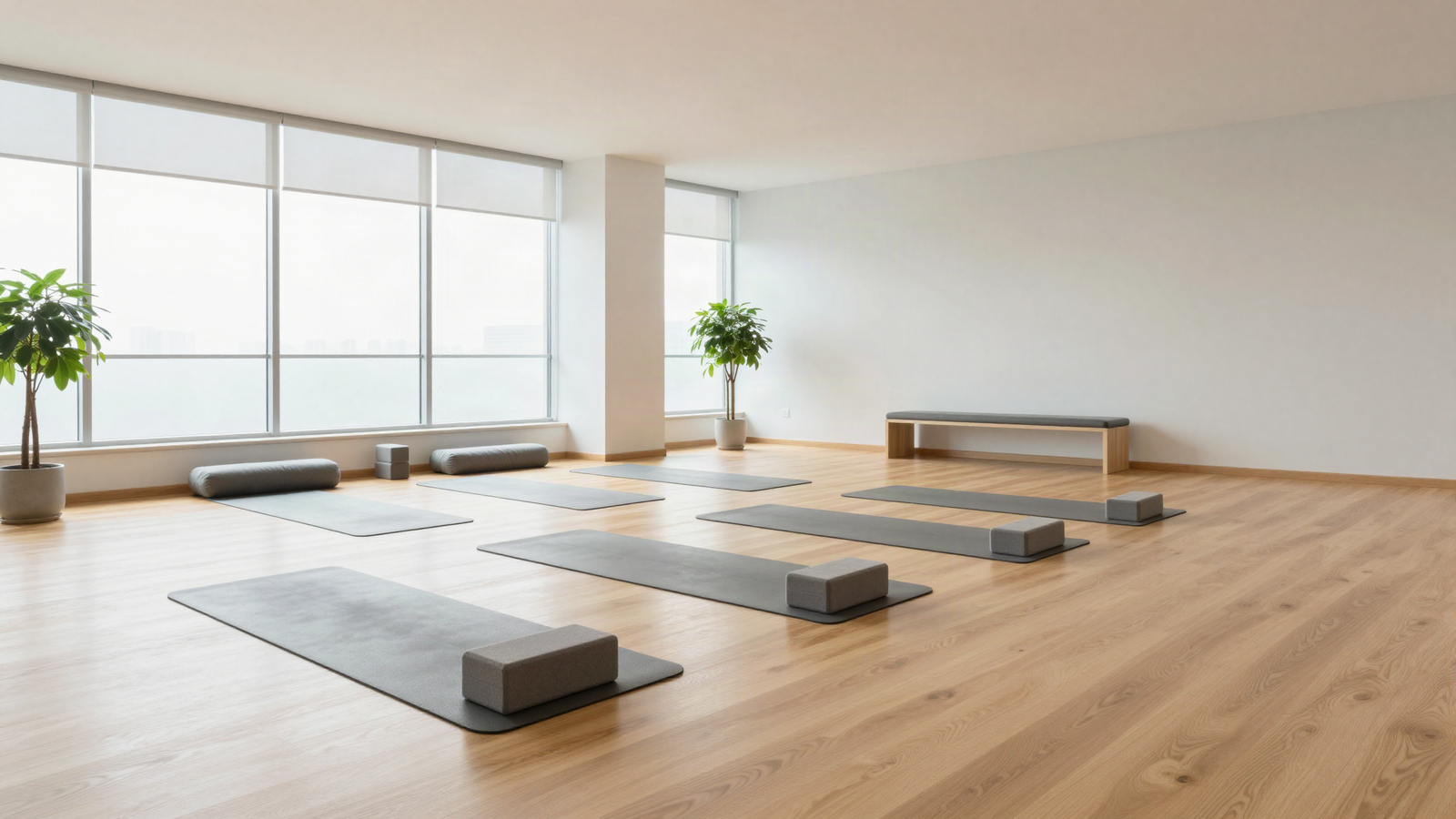
A fitness department is four systems — programming, people, operations, and measurement. A corporate office and a luxury residential building change the constraints on those systems. They do not change the systems themselves. The job of a Fitness Director and wellness programmer is to own all four so the organization gets a program instead of a room with equipment in it.
Most organizations never decide to build a fitness department. They accumulate one.
A room gets built during construction. A vendor gets hired for a yoga class. Someone’s assistant books a six-week challenge in January. An instructor cancels twice and quietly stops being replaced. Eighteen months later a leader asks why participation is flat, and nobody owns the answer — because nobody ever owned the department.
I have run this work on both sides: fitness and lifestyle programming across luxury residential properties in Seattle, and corporate wellness through Origins Unity. The environments feel different. The underlying management problem is the same one.
Four systems. Everything else is a detail of one of them.
Programming — deciding what runs, for whom, when, and why. People — finding, onboarding, and supporting the instructors who deliver it. Operations — scheduling, payroll, vendor contracts, space, signage, and communication. Measurement — knowing whether it is working and having a defined moment where you change it.
A program fails when one of these has no owner. Usually it is the fourth.
The instinct in both settings is to pick classes first. I would rather spend the first three to four weeks watching.
In a residential building, that means learning when the fitness room is busy and when it is empty, which equipment gets touched and which is decoration, and what the leasing and concierge teams hear at the desk. Front-of-house staff hear the real objections: the room feels intimidating, the hours do not work, someone tried once and nobody spoke to them.
In a corporate setting, the same questions take a different shape. When are people actually free — and is that the same time their calendar says they are free? Which teams are on site which days? Is there a private space, or are we asking someone to do floor work in a glass conference room their colleagues walk past?
The CDC’s framework for workplace health promotion puts assessment before planning for exactly this reason: you assess the health needs of the workplace, then plan, implement, and build an environment that supports the program, then evaluate whether it is working (CDC, Work@Health Program). That order is not bureaucratic. It is what keeps you from building a calendar for a population that does not exist.
Then I launch small. Three to five sessions covering distinct needs — one low-barrier entry point for people who are not currently exercising, one strength or conditioning format, one recovery or mobility offering — placed at the times the assessment suggested. I run a defined cycle, usually six to eight weeks, and I say in advance what happens at the end of it: what gets kept, what moves, what gets cut.
Announcing that cycle matters. It gives participants a reason to start now, and it gives the organization a review date instead of an open-ended obligation. It is the same structure behind every group program I build.
Nobody experiences your programming philosophy. They experience the person standing in front of them.
So instructor selection and support is where I spend a disproportionate share of my time. In practice that means a working audition rather than a résumé review. A written expectation for what the first five minutes with a new participant look like. A coverage plan, so a cancellation does not become a client-facing or resident-facing failure. And regular check-ins that are coaching conversations, not scheduling calls.
An instructor who scales a movement for a beginner without making it a moment does more for retention than any equipment purchase. In a corporate setting, one bad first session can cost you an employee permanently — they will not try again, and they will tell two colleagues. In a residential building, it costs you a resident who now walks past the fitness room instead of into it.
Hiring and supporting that bench is department management, not coaching. So is the unglamorous half: contracts, insurance and certification tracking, payroll coordination, substitute pools, and knowing who you can call on a Tuesday morning when someone is sick.
A class nobody can find did not happen.
I treat signage, the resident app or employee intranet, elevator screens, and the front-desk script as program infrastructure rather than marketing. Every session needs a consistent answer to four questions: what it is, who it is for, whether registration is required, and what to bring. Ambiguity on any one of those filters out exactly the people you were trying to reach — the hesitant ones.
Vendor coordination belongs here too. Equipment service, cleaning standards, music licensing, towel service, mat replacement. None of it is interesting. All of it is visible to a participant the moment it slips.

Programming fails quietly when nobody owns the review.
I recommend a short monthly summary to whoever holds the budget — a property manager, an HR lead, a head of workplace experience. Attendance by session and time slot. Repeat versus first-time participants. Instructor consistency. Comments received. And one recommended change, with the reasoning behind it.
One page. The point is not reporting for its own sake. It is making the program something the organization can steer instead of something it renews or cancels on instinct.
I would be careful about what you claim from those numbers. Participation, repeat attendance, and service consistency are things you can observe directly. Renewal rates, retention, and property value are business considerations worth discussing, but attributing a change in them to a fitness program requires evidence specific to that organization. I would rather give a leader a measure they can trust than a number they cannot defend in a budget meeting.
Three things, in my experience.
Who the participant is to the organization. In a corporate setting, the employer is paying to support an employee. In a residential building, the resident is paying for an amenity they were promised during a tour. The second carries a service expectation closer to hospitality.
What time means. Corporate programming competes with meetings and has to survive a calendar invite. Residential programming competes with the rest of someone’s evening, and it has to be worth leaving the apartment for.
What success looks like. A corporate wellness program is usually judged on reach — how much of the workforce it touches. Residential programming is judged on experience — whether the people who show up feel looked after. Both matter in both settings. The emphasis shifts.
Everything else — the assessment, the small launch, the instructor standard, the review rhythm — carries straight across. NAA has argued that as premium amenities became standard across Class A properties, the differentiator shifted from the facility to the resident experience around it (NAA, “Resident Experience vs. Amenities”). The same thing has happened in corporate real estate. The gym is not the differentiator. The program is.
Someone to own all four systems, and the judgment to know which one is broken.
When participation is flat, the cause is rarely the equipment. It is a schedule built on assumptions, an instructor who is not supported, communication nobody can find, or a review that never happens. Those are management problems with management fixes, and they are the same fixes in an office tower and a residential high-rise.
NAA’s coverage of resident retention points to programming as one of the few recurring reasons people leave their unit and connect with neighbors (NAA, “Driving Resident Retention”). The workplace version is the same instinct: a standing reason to step away from a desk and be in a room with other people. Lower-intensity formats carry that load well — the breathwork sessions I run in Seattle draw people who would never sign up for a conditioning class.
A fitness department is not a room. It is a set of decisions somebody has to make every month. That is the work.
1. What does a Fitness Director do?
A Fitness Director owns the programming, the instructor team, the operations, and the measurement of a fitness program. That includes assessing who the program serves, building and revising the schedule, hiring and supporting instructors, coordinating vendors and payroll, handling signage and communication, and reporting results to whoever holds the budget.
2. What is the difference between corporate wellness programming and residential fitness programming?
The method is the same; the constraints differ. Corporate programming competes with meetings and is usually judged on how much of the workforce it reaches. Residential programming competes with the rest of a resident’s evening and is judged on service experience, closer to hospitality. Assessment, small launches, instructor standards, and a monthly review apply to both.
3. How do you measure whether a fitness program is working?
Start with measures you can observe directly: attendance by session and time slot, repeat versus first-time participants, instructor consistency, and participant feedback. Treat renewal rates, retention, and property value as business considerations rather than proven outcomes, unless you have evidence specific to that organization.
4. How many classes should a new fitness program start with?
Fewer than most organizations expect. Three to five sessions covering distinct needs, placed at times an assessment supports, run on a defined six-to-eight-week cycle. A full calendar on day one looks generous and hides information — if eleven classes run and four fill, you have learned very little about why.
5. Does an organization need a full-time Fitness Director?
Not always. What it needs is a single owner for all four systems. Smaller programs are often better served by a consultant who builds the structure, hires and trains the instructor team, and hands over a schedule and a monthly review the internal team can actually run.

Origins Unity is a Seattle wellness company that helps people and teams feel better and work better. We bring breathwork, holistic fitness, meditation, and qigong to corporate wellness programs, small groups, and one-on-one coaching. In person across Puget Sound, virtual nationwide.
Copyright © 2026 | Origins Unity LLC | Website Designed By 1Solutions
David Reveles is a Fitness & Lifestyle Director leading fitness and lifestyle programming across luxury residential properties in Seattle, and the founder of Origins Unity, a holistic fitness and wellness company. He holds CAPM, Lean Six Sigma Black Belt, and ITIL project management certifications alongside NASM CPT and credentials in breathwork, trauma-informed mindfulness, yoga, qi gong, nutrition, and workplace wellness. To discuss fitness department design for a property or workplace, see corporate programs or get in touch.