
Grounded professional building resilience and learning how to respond to stress
When stress becomes overwhelming, many people cope by completely avoiding the source of it.
We put off the difficult conversation. We ignore the growing list of responsibilities. We distract ourselves with food, alcohol, entertainment, social media, work, or anything else that provides temporary relief.
Sometimes, we simply tell ourselves that we will deal with everything later.
Avoidance can create a brief sense of safety, but the stressor usually remains. The unanswered email, unresolved conflict, financial concern, health issue, or neglected responsibility continues occupying mental and emotional space.
The goal of stress management is not to escape everything difficult. It is to develop the bandwidth and stamina to face what life puts in front of us without becoming overwhelmed, reactive, or depleted.
This is where holistic fitness and wellness become essential.
Stress avoidance happens when we repeatedly distance ourselves from uncomfortable situations, emotions, decisions, or responsibilities rather than addressing them.
It can look like:
Avoidance is not always laziness or a lack of discipline. It can be a protective response when the nervous system believes that a situation exceeds our current capacity.
There are also moments when temporarily stepping away is the intelligent choice. A strategic pause can help us regulate, gather information, and return with a clearer mind. The problem begins when the pause becomes a permanent pattern and nothing gets resolved.
Stress is a normal response to pressure. It becomes harmful when it repeatedly disrupts our health, decisions, relationships, or ability to function.
The American Psychological Association explains that stress is a normal reaction to everyday pressures, but it can become unhealthy when it interferes with daily life.
Unresolved stress can keep consuming attention even when we are not actively thinking about it. We may feel distracted, irritable, mentally foggy, physically tense, or exhausted without recognizing how much unfinished stress we are carrying.
Over time, prolonged stress can influence:
Chronic stress is not merely “in your head.” It can have cumulative physiological and psychological effects. That does not mean every stressful period will cause illness, but it does mean that consistently ignoring stress is not a sustainable performance strategy.
Many high performers have been trained to respond to every problem with more effort.
Work harder. Exercise harder. Sleep less. Drink more caffeine. Stay busy. Keep going.
This approach can work temporarily, but it does not create unlimited capacity. When the body and mind are already depleted, adding more pressure can deepen the problem.
You cannot consistently outperform a nervous system that never gets an opportunity to recover.
Real high performance includes knowing when to push, when to pause, and how to recover. It requires enough self-awareness to recognize whether you need more discipline, more support, or more restoration.
Recovery is not the opposite of productivity. Recovery is what allows productive effort to remain available.
High performance is recovery.
Healthy stress management does not mean removing every responsibility or remaining calm every second of the day.
It means expanding your capacity to experience pressure without losing your ability to think clearly and act intentionally.
Think of stress capacity like physical conditioning. If every difficult situation immediately pushes you beyond your limits, avoidance becomes more tempting. As your capacity grows, you gain more room between the stressor and your reaction.
Within that space, you can choose your next action instead of operating entirely from fear, frustration, exhaustion, or urgency.
Holistic wellness builds this capacity by supporting the interconnected systems that influence how we respond to stress:
Stress rarely exists in only one domain. A workplace challenge can disrupt sleep. Poor sleep can increase cravings and reduce patience. Reduced patience can affect relationships. Relationship tension can make concentration more difficult.
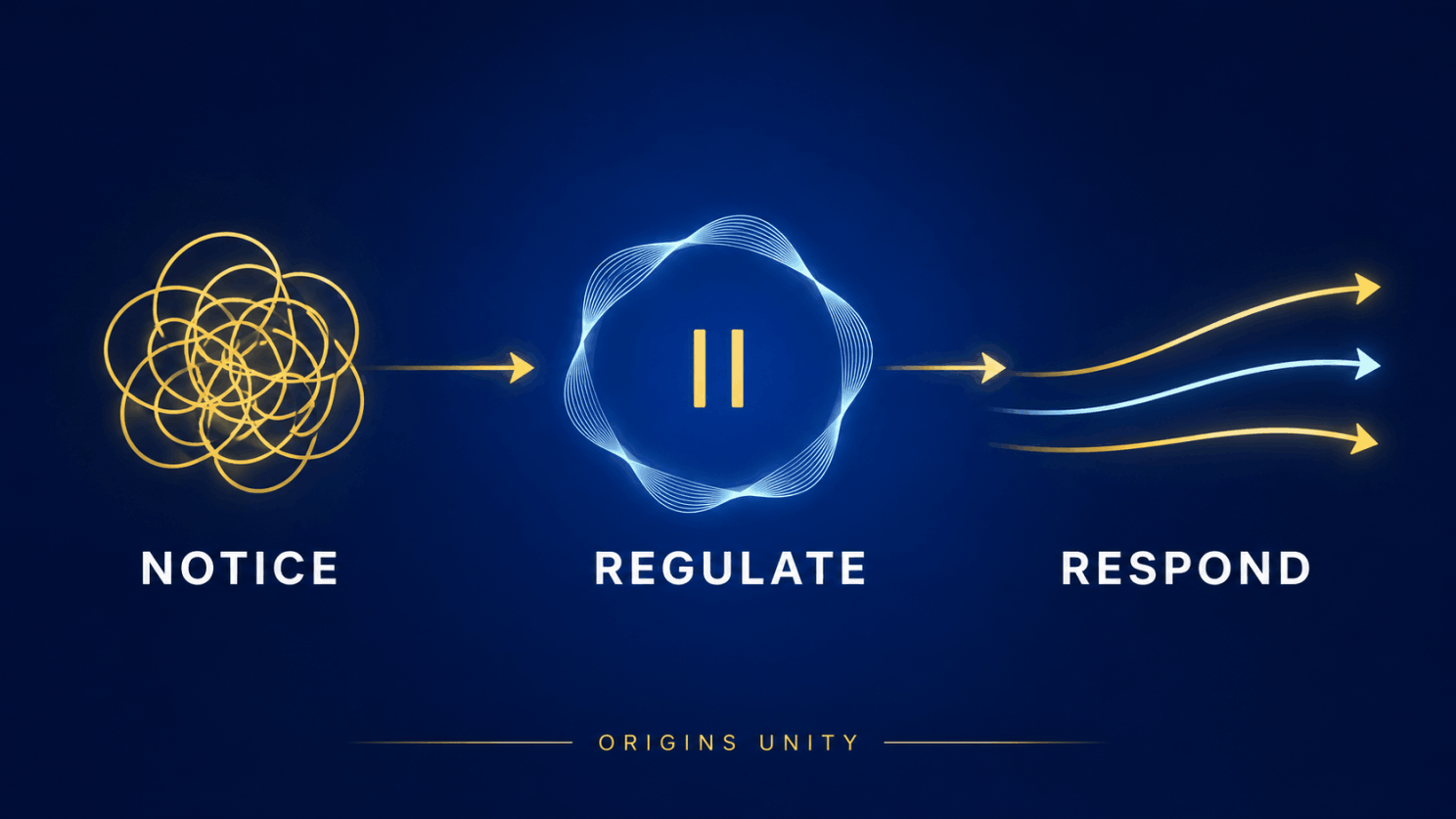
When you are highly activated, your first interpretation of a situation may not be your clearest one.
Before responding to a difficult email, conversation, or decision, give your body a chance to settle.
Try this:
The purpose is not to force yourself to feel peaceful. It is to create enough space to choose a more deliberate response.
The CDC recommends focused breathing, stretching, meditation, journaling, time outdoors, and other restorative activities as healthy ways to cope with stress.
Stress often feels like one enormous problem until it is clearly named.
Ask yourself:
Clarity reduces the amount of energy spent circling the problem.
Do not wait until you feel completely confident or motivated.
Send the email. Schedule the appointment. Open the document. Ask for clarification. Make the phone call. Write the first paragraph.
The first action does not need to solve everything. It only needs to interrupt the pattern of avoidance.
A useful rule is: regulate first, then take one responsible step.
Movement gives accumulated stress energy somewhere to go.
This does not always require an intense workout. Depending on your condition and energy level, movement might include:
Physical activity can provide immediate benefits for mood, cognition, sleep, and short-term anxiety, according to the CDC.
The goal is not to punish your body for feeling stressed. It is to use movement to support regulation, health, and recovery.
When life becomes demanding, recovery is often the first thing people sacrifice.
Unfortunately, this reduces the very capacity needed to handle those demands.
Protect the fundamentals:
When recovery improves, challenges do not necessarily disappear—but your ability to respond to them often changes.
Emotions contain information. They may point toward a violated boundary, an unmet need, uncertainty, grief, fear, exhaustion, or conflict between your actions and values.
Processing an emotion does not mean allowing it to control every decision. It means acknowledging what is present so that it does not have to keep demanding your attention.
Helpful practices can include:
Research summarized by the National Center for Complementary and Integrative Health suggests that mindfulness and meditation may be helpful for some people, although results vary and these practices should not be treated as universal cures.
You do not have to wait until you are completely overwhelmed to ask for help.
Support can come from:
Social connection can strengthen our ability to manage stress and support better sleep and health behaviors, according to the CDC.
Asking for help is not an admission that you are incapable. It is often a sign that you are responding to the situation intelligently.
Holistic fitness is not about remaining relaxed while life falls apart around you. It is about developing the ability to adjust your output based on what the moment requires.
Sometimes you need intensity. Sometimes you need recovery. Sometimes you need stillness, movement, nourishment, emotional processing, clearer boundaries, or a difficult conversation.
To throttle the chaos means that you do not have to operate at full speed all the time.
You can reduce unnecessary stimulation, regulate your nervous system, restore your energy, and then apply effort where it matters most.
That is how we become high performers without losing our humanity.
It is also how we remain grounded, reasonable, and sensible when circumstances become chaotic.
The next time you catch yourself avoiding something stressful, use this short process:
Minute 1: Notice
Identify what is happening in your body and mind without immediately judging it.
Minute 2: Breathe
Slow your breathing and allow the exhale to lengthen comfortably.
Minute 3: Name
Write down the specific situation you are avoiding.
Minute 4: Choose
Identify one small, responsible action you can take.
Minute 5: Begin
Start the action before your mind creates another reason to delay.
This practice will not solve every complex problem in five minutes. It can, however, help you shift from avoidance toward intentional action.
You will not respond perfectly to every stressful situation. No one does.
The goal is to notice your patterns earlier, recover more effectively, and return to responsible action more quickly.
Stress management is not about creating a life in which nothing difficult happens. It is about developing the physical, mental, emotional, and social resources to face difficulty without abandoning yourself.
Holistic fitness and wellness give us more than a stronger body. They help us develop the bandwidth, stamina, and self-awareness to meet the demands of our lives.
You cannot control everything that gets thrown at you.
But you can train your ability to respond.
If stress, fatigue, poor sleep, inconsistent exercise, or burnout are reducing your ability to perform, Origins Unity can help you build a whole-person plan around your health, energy, and real life.
Book a complimentary 15-minute consultation with Origins Unity.
This article is educational and is not a substitute for medical or mental-health care. If stress, anxiety, depression, or burnout is interfering with your daily life, consider speaking with a qualified healthcare professional.
Is avoiding stress always unhealthy?
No. Temporarily stepping away from a stressful situation can be useful when you need time to regulate your emotions, gather information, or recover your energy. Avoidance becomes problematic when it turns into a repeated pattern that prevents you from addressing important responsibilities, decisions, emotions, or relationships..
Why do I avoid things when I feel stressed?
Avoidance can be a protective response. When a situation feels threatening, uncertain, or beyond your current capacity, your nervous system may push you to escape, delay, shut down, or distract yourself. This is not always a lack of discipline. It may be a sign that you need to regulate your stress before deciding what action to take.
What are common signs of stress avoidance?
Common signs include procrastination, emotional withdrawal, excessive screen use, overworking, neglecting responsibilities, avoiding difficult conversations, stress eating, using alcohol to disconnect, and keeping yourself constantly busy. You may also notice that unfinished tasks continue occupying your thoughts even when you try to ignore them.
How can I stop avoiding stressful situations?
Begin by naming the specific situation you are avoiding. Regulate your body with slow breathing, movement, or a short pause, and then choose the smallest responsible action available. You do not need to solve the entire problem immediately. The objective is to interrupt avoidance and begin moving toward resolution.
What is holistic stress management?
Holistic stress management addresses the interconnected physical, emotional, mental, social, occupational, environmental, and lifestyle factors that influence stress. It may include breathwork, movement, sleep, nutrition, mindfulness, emotional processing, social support, clearer boundaries, and practical problem-solving.
How does exercise help with stress management?
Physical activity can reduce short-term feelings of anxiety, support sleep, improve mood, and provide a healthy outlet for accumulated tension. Exercise does not need to be extremely intense to be beneficial. Walking, strength training, mobility work, yoga, qigong, dancing, and other appropriate forms of movement can all support stress management.
Can breathwork help regulate stress?
Slow, controlled breathing may help reduce physiological arousal and create space between a stressful event and your response. A simple practice is to breathe gently through the nose and allow the exhale to be slightly longer than the inhale. Breathwork should be comfortable and should not replace professional care when stress or anxiety significantly interferes with daily life.
What is the difference between stress management and stress avoidance?
Stress avoidance attempts to escape or ignore the source of discomfort. Stress management helps you regulate your response, recover your energy, understand the situation, and take appropriate action. Healthy stress management does not eliminate every challenge; it strengthens your ability to face challenges intentionally.

Origins Unity is a Seattle wellness company that helps people and teams feel better and work better. We bring breathwork, holistic fitness, meditation, and qigong to corporate wellness programs, small groups, and one-on-one coaching. In person across Puget Sound, virtual nationwide.
Copyright © 2026 | Origins Unity LLC | Website Designed By 1Solutions