
If your lower back feels tight after a long day at a desk, the answer
is usually not “stretch only” or “strengthen only.” A short, comfortable
mobility drill may help you move more easily now. Progressive strength
work can help you build the capacity to sit, stand, bend, carry and
train with more confidence over time.
The important word is may. A feeling of tightness is
a sensation, not a diagnosis. It does not tell you by itself whether a
muscle is short, weak, tired, guarded or responding to something outside
a fitness coach’s scope.
For familiar, mild stiffness that improves when you move, a useful
approach is:
- Test one simple task.
- Use a small amount of comfortable movement.
- Add an appropriate strength exercise.
- Test the same task again.
That gives you better information than repeatedly stretching the area
because it feels tight.
Why a
Tight Back Does Not Automatically Need More Stretching
People often use “tight” to describe several different experiences:
stiffness after sitting, reluctance to bend, fatigue around the hips or
trunk, a protective feeling after unfamiliar activity, or pain that is
difficult to describe.
Those experiences can overlap, but they are not interchangeable. A
strong stretch may feel useful for one person and irritating for
another. The sensation may also return quickly if the larger issue is
prolonged positioning, a sudden change in training load, low movement
variety, limited recovery or a need for progressive strength.
This is why the exercise guidelines do not reduce low-back care to
one stretch or one “core” drill. The World Health Organization supports
structured exercise as one possible part of care for chronic primary
low-back pain, while noting that the evidence is not strong enough to
declare one exercise modality universally best. Current physical-therapy
guidance includes mobility, trunk strength and endurance, general
exercise, aerobic work and movement-control training, selected for the
individual.
The practical lesson for a desk worker is not that every form of
exercise works equally well. It is that your response, goals and
clinical context matter more than the label on the exercise.
When Stretching Can Be
Useful
Stretching or gentle mobility may be useful when it helps you move
with less effort and does not create sharper, spreading or lingering
symptoms.
It may fit when:
- you have been in one position for a long time;
- the sensation is familiar and mild;
- a comfortable movement makes standing or walking easier;
- you are warming up for activity rather than trying to force a
permanent correction; or - you simply enjoy the practice and recover well from it.
Think of stretching as a way to explore range and comfort, not as
proof that you have lengthened the one muscle responsible for the
problem.
Use the smallest useful dose
You do not need to chase the strongest sensation. Try 15 to 30
seconds of a comfortable position or four to six slow repetitions of a
gentle movement. Keep breathing normally. Stop if symptoms become sharp,
begin traveling down the leg, or include numbness or tingling.
Then retest the task that felt stiff. If walking, standing or bending
feels easier, the movement may be useful as a short-term tool. If
nothing changes, doing the same stretch harder is not automatically the
answer.
When Strengthening Matters
More
Strength work addresses a different question: can your trunk, hips
and legs tolerate the demands you repeatedly place on them?
Desk work itself is not a strength exercise. Standing up occasionally
is useful, but it does not replace progressive training. Strengthening
can help build capacity for everyday tasks such as getting out of a
chair, lifting groceries, carrying a bag, using stairs and returning to
recreational activity.
Clinical guidance for chronic low-back pain supports several active
approaches, including trunk strengthening and endurance, general
resistance exercise, aerobic exercise and multimodal programs. A 2026
dose-response review of 239 trials found that low-to-moderate exercise
doses were associated with short-term improvements, but the certainty
was low to very low and the evidence did not support one universal
optimal dose.
That limitation is important. More is not automatically better, and a
research average is not an individual prescription.
Strength should be
progressive, not punishing
For someone with familiar, mild stiffness and no concerning symptoms,
examples of low-complexity patterns include:
- sit-to-stand from a stable chair;
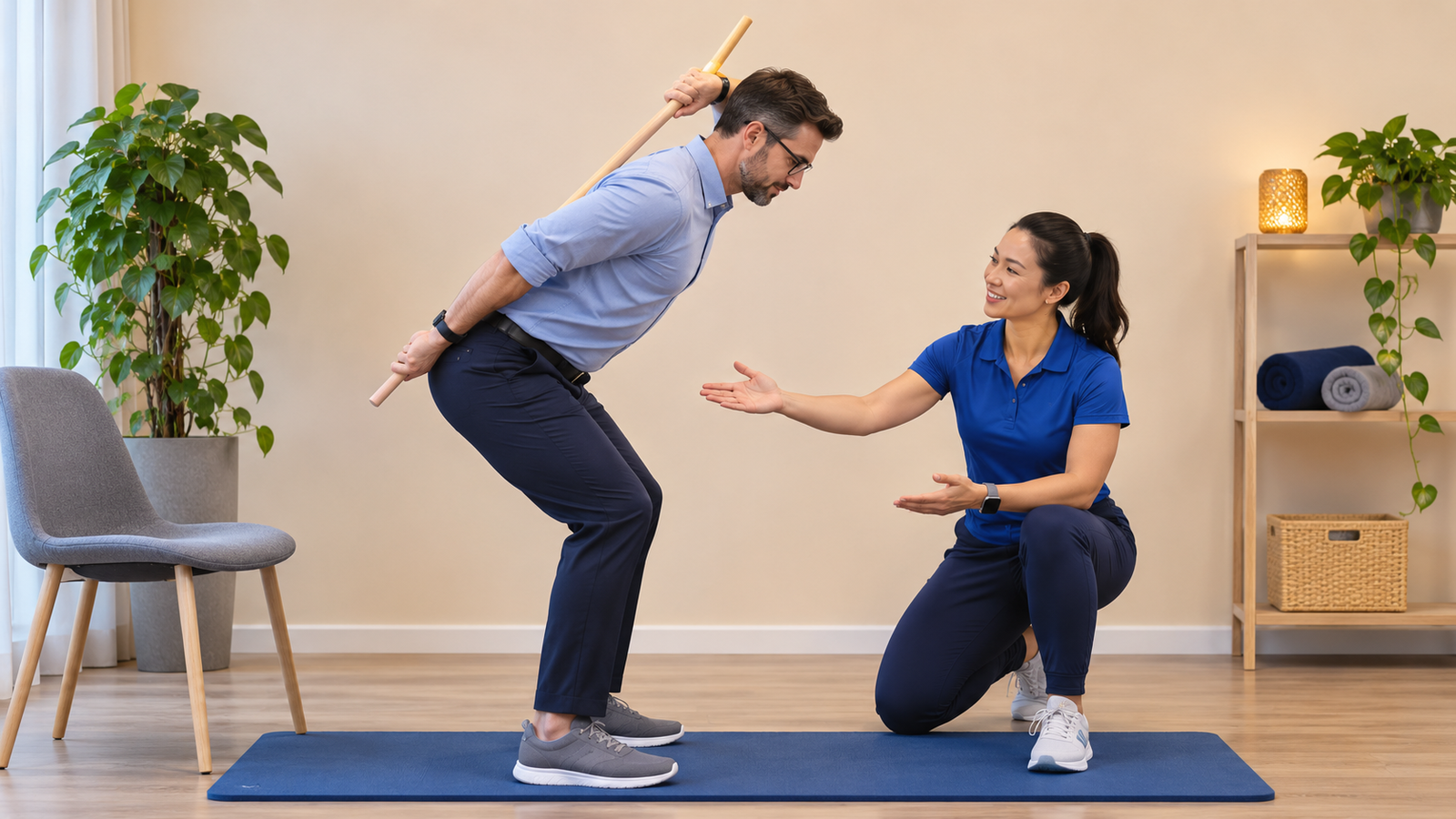
- a supported hip hinge practiced with a wall or dowel;
- a bridge, if lying on the floor is comfortable;
- a supported split stance or step-up;
- a light carry; or
- a trunk-endurance exercise selected for the person.
The exercise name matters less than the response. Use a range you can
control. Leave several repetitions in reserve. Increase one variable at
a time: repetitions, load, range or sets.
If you have an injury, diagnosed condition, symptoms into the leg or
uncertainty about safe exercise, get individualized guidance rather than
building a routine from a general article.
The Test–Train–Retest Method
This method turns a vague sensation into a practical observation. It
is not a diagnostic test.
Step 1: Choose one simple
task
Pick a movement you already need to do: stand from a chair, walk for
one minute or make a shallow hip hinge. Rate comfort from 0 to 10, where
0 is no concern and 10 is the most intense symptom you can imagine. You
are looking for change, not proving toughness.
Step 2: Change the position
Walk for one to two minutes. If you have been sitting, the position
change alone may be enough to alter the sensation.
Step 3: Try one
comfortable mobility option
Choose one movement that feels familiar and controlled: a small
standing pelvic movement, a gentle side reach, a supported hip shift or
another drill already approved for you. Use four to six repetitions or
one short hold.
Step 4: Add one strength
pattern
Try one set of six to ten controlled chair stands or supported hip
hinges. Keep the effort moderate. Stop if the symptoms become sharper,
spread or leave you less confident in the movement.
Step 5: Retest the original
task
Repeat the chair stand, walk or shallow hinge.
- Better: keep the useful piece and repeat it
later. - No change: do not force more range or load. Try a
different movement another day or seek guidance. - Worse: stop the experiment and return to a
comfortable activity. Persistent or concerning symptoms deserve
evaluation.
The goal is not to find a magical exercise. It is to learn which
input helps you move more comfortably and which one does not.
A Seven-Minute
Desk-to-Movement Reset
For familiar, mild stiffness without red-flag symptoms, this can be a
starting template. It is not a treatment plan.
Minute 1–2: Walk
Leave the desk and walk at an easy pace. Let your arms move
naturally.
Minute 3: Explore
comfortable motion
Use four to six slow repetitions of one gentle movement. Keep the
range smaller than your maximum.
Minute 4–5: Practice
a hinge or chair stand
Complete one or two easy sets. Choose the option you can control
without holding your breath or pushing into pain.
Minute 6: Add a second
whole-body pattern
Choose a supported step-up, split stance, light carry or another
familiar exercise.
Minute 7: Retest and record
Repeat the original task and note one sentence: better, unchanged or
worse. That simple record is more useful than assuming every tight-back
day needs the same routine.
If you want a broader plan, Origins Unity’s guide to fitness
for people who work at desks covers movement breaks, strength and
cardio. The technology-professional
fitness guide explains how to fit those practices into a demanding
week.
What to Do Across the Week
A useful weekly plan has three layers.
1. Break up long
periods in one position
Change position regularly. Walk to refill water, take a call standing
or use two minutes between meetings. This is movement variety, not a
posture correction.
2. Train strength
consistently
Use two or more planned sessions when that schedule is appropriate
for you. Train the whole body rather than trying to isolate one
supposedly weak back muscle. The article on getting
your energy back from a desk job gives a broader framework for
matching training intensity to recovery.
3. Keep a smaller
version for difficult weeks
When the week changes, reduce volume before abandoning the routine.
One or two exercises can preserve the practice until normal training
fits again. That is different from turning a temporary minimum into the
permanent plan.
When a
Tight Back Needs More Than a Fitness Article
Seek prompt professional evaluation when back symptoms are new,
severe, worsening, persistent or outside your usual pattern. Immediate
assessment is especially important for severe low-back pain with new
bladder, bowel or sexual-function changes, new numbness around the groin
or saddle area, or progressive weakness. Significant trauma, fever or
unexplained systemic symptoms also require medical attention.
Pain traveling down a leg, persistent numbness, tingling or weakness
should not be managed by repeatedly stretching harder. A qualified
healthcare professional can determine whether clinical evaluation,
physical therapy or another pathway is appropriate.
Coaching and fitness programming can support movement, strength and
recovery after appropriate screening. They do not diagnose or treat a
medical condition.
Frequently Asked Questions
Should I stretch
a tight lower back every day?
Not automatically. A small amount of comfortable stretching may help
some people move more easily, but the sensation of tightness does not
prove that more stretching is the missing solution. Retest a useful task
and include progressive strength when appropriate.
Is
strengthening better than stretching for lower-back stiffness?
They serve different purposes. Stretching or mobility can support
short-term comfort and range. Strengthening builds capacity over time.
Guidelines support several forms of exercise and do not identify one
universal best method for everyone.
Can sitting cause lower-back
pain?
Long, uninterrupted sitting may be one contributing factor, but back
pain is rarely explained by one position alone. Activity level,
workload, sleep, stress, prior symptoms, health conditions and
individual tolerance can all matter.
What is the
best exercise for a tight lower back?
There is no single best exercise for every person. A useful exercise
is appropriate to your symptoms and goals, feels controllable, and can
be progressed without producing concerning symptoms.
Should I strengthen my core?
Trunk strength and endurance can be useful parts of a whole-body
program. “Core” work is not one exercise and does not need to dominate
every session. Hips, legs, upper body, aerobic capacity and normal daily
movement also contribute to overall capacity.
When should I stop
exercising and seek help?
Stop and seek appropriate guidance if symptoms become severe, rapidly
worsen, spread down the leg, or include numbness, weakness or other
neurological changes. New bladder or bowel changes or saddle-area
numbness require immediate assessment.
Stretch for
Comfort. Strengthen for Capacity.
A tight lower back does not need to become a daily argument between
mobility and strength. Use gentle movement when it helps you move more
comfortably. Use progressive strength to build what your work and life
ask you to tolerate. Retest the task, keep the useful input and stop
treating intensity as proof that the exercise is working.
If you want a plan built around your schedule, current capacity and
response to training, explore Fatigue
to Fit. Genetics is optional and is not needed to begin. Persistent
or concerning back symptoms should be evaluated by an appropriate
healthcare professional before coaching progresses.
About David Reveles
David Reveles is the founder of Origins Unity and a Fitness and
Lifestyle Director in Seattle. He holds CAPM, Lean Six Sigma Black Belt,
ITIL and NASM CPT credentials, is an Oxygen Advantage instructor, and
holds training or credentials in breathwork, trauma-informed
mindfulness, yoga, qi gong, nutrition, meditation and workplace
wellness. His work draws on more than 25 years in fitness, martial arts,
movement and coaching.
References
- World Health Organization. WHO
guideline for non-surgical management of chronic primary low back pain
in adults in primary and community care settings. 2023. The exercise
recommendation is conditional and based on low-certainty evidence; the
guideline states that one modality cannot be identified as universally
superior. - George SZ, et al. Interventions
for the Management of Acute and Chronic Low Back Pain: Revision
2021. Journal of Orthopaedic & Sports Physical Therapy.
2021. The guideline supports multiple exercise categories and notes
heterogeneity, small samples and short follow-up in much of the
evidence. - NICE. Low
back pain and sciatica in over 16s: assessment and management.
Current guidance reviewed November 13, 2026. It recommends
self-management and advice to continue normal activities when
appropriate. - NICE. Suspected
neurological conditions: recognition and referral. Current guidance
reviewed November 13, 2026. It identifies severe back pain with new
bladder, bowel or sexual-function changes or perineal numbness as
requiring immediate referral for possible cauda equina syndrome. - Optimal exercise
dose in adults with chronic low back pain disorders: systematic review
with dose-response network meta-analysis. 2026. The review included
239 trials but rated 84% at high risk of bias and the certainty as low
to very low; it did not establish one universal optimal dose. - Effects of
different exercise interventions on lower back pain: a systematic review
and meta-analysis. 2026. Exercise findings varied by intervention
and outcome; the review described evidence for stretching as
inconclusive.

Medical and scope disclaimer
This article is educational and does not diagnose or treat low-back
pain or another medical condition. Exercise response varies. Seek
individualized guidance for injuries, diagnosed conditions, symptoms
into the leg, neurological changes, persistent or severe pain, or
uncertainty about safe participation. Emergency symptoms require urgent
medical care.