
You close the laptop, but the meeting continues in your head.
You replay a message you sent. You remember one more task. You reach
for your phone while making dinner and find yourself back in work mode
before you have actually entered the rest of your life.
This is common in mentally demanding work. A clear end to the workday
may exist on the calendar without existing in your attention. Remote and
hybrid work can make that boundary even less visible because the same
room, device and chair may serve both professional and personal
life.
The answer is not to force yourself to feel calm. It is not to
pretend the work does not matter. It is to give the mind and body a
clear sequence that says: this part of the day is ending, and
another part is beginning.
That is the purpose of an after-work transition ritual.
The one below takes about 10 minutes. It combines practical closure,
a change of environment, gentle Qi Gong-inspired movement, mindful
attention and a deliberate choice about what comes next. None of those
elements is magic. Together, they create a repeatable bridge between
work and the rest of your life.

A transition ritual creates a visible boundary between the
workday and personal time.
What does it mean to
switch off after work?
Occupational-health researchers often use the term
psychological detachment. It means being away from work
both behaviorally and mentally during nonwork time: not only stopping
job tasks, but also getting some distance from work-related
thoughts.
Detachment is not indifference. It does not mean you care less about
your work or ignore a genuine responsibility. It means your attention is
not required to remain at work continuously after the work period has
ended.
A 2023 systematic review examined 159 empirical studies on factors
that help or interfere with detachment. The review describes detachment
as an important part of recovery and points to both individual and
job-level influences. In other words, switching off is partly a skill,
but the design of work also matters. Heavy workload, unclear
expectations, constant connectivity and limited control can make
detachment harder. See the review in the Journal of Occupational
Health Psychology: Facilitating detachment
from work.
That distinction matters. A ritual can support recovery. It cannot
make an unreasonable workload reasonable.
Why a transition ritual can
help
Many people wait for a relaxed feeling to arrive before they begin
personal time. A more dependable approach is to begin with behavior.
Close the loop you can close. Change location. Move differently.
Direct your attention to what is physically present. Choose what you are
doing next.
These actions provide several useful signals:
- Closure: You capture unfinished work instead of
trying to remember it all evening. - Context change: You stop using the same posture,
screen and environment that maintained work mode. - Movement: You interrupt the stillness and muscular
tension of desk work without turning recovery into another workout. - Attention: You notice your surroundings rather than
continuing to rehearse the day. - Choice: You enter personal time through something
you value instead of falling directly into more scrolling.
In a randomized controlled trial of 393 participants, both a
mindfulness-based intervention and a cognitive-behavioral intervention
improved psychological detachment over time. That does not prove that
the 10-minute routine in this article will produce the same result; the
study tested structured interventions over a longer period. It does
support the broader idea that detachment can be practiced rather than
treated as a personality trait. Read the study abstract: Mindfulness and
cognitive-behavioral strategies for psychological detachment.
The 10-minute
Integrated Living transition ritual
Integrated Living means bringing useful practices into ordinary life
rather than reserving them for a class, retreat or perfect morning
routine. This transition is intentionally simple enough to use at the
end of a normal workday.
You do not need special clothing, equipment or experience. Keep the
movement comfortable. If a step does not suit your body or environment,
change it or leave it out.
Minutes 0–2: Close the work
loop
Before you close the computer, write three short lines:
- What I completed: Name one meaningful thing that
moved forward. - What remains: Capture the unfinished item that is
most likely to follow you into the evening. - The next visible action: Write the first small step
you will take when you return.
For example:
Completed: Sent the revised project brief.
Remains: Confirm the implementation timeline.
Next action: Ask the engineering lead for the two missing estimates.
This is not an invitation to plan the entire next day. The goal is to
stop using your memory as an open task manager.
Then use one consistent shutdown cue. It can be as plain as closing
the laptop, turning off the desk lamp and saying, “Work is complete for
today.” The words do not need to feel profound. Repetition is more
important than intensity.
If you are on call or truly need to remain reachable, define the
boundary honestly: what type of alert requires action, through which
channel, and what can wait. A vague state of permanent availability is
not the same as a clear on-call agreement.
Minute 2–3: Change the scene
Stand up and leave the immediate workspace, even if you return to the
same room later.
- Put the laptop out of sight or cover the monitor.
- Change the lighting.
- Wash your hands or face.
- Step onto a balcony, into a hallway or outside the building.
- Change from work clothes into something comfortable.
The action should be easy enough to repeat. You are creating a
doorway, not a ceremony that requires perfect conditions.
If you work on site, your commute may already provide a transition.
Use the first minute after leaving the building to make it deliberate:
silence work notifications, notice your surroundings and decide what the
trip home is for. It could be quiet, music, a call with someone you care
about or simply looking out the window if you are not driving.
Minutes 3–6:
Use gentle Qi Gong-inspired movement
Desk work asks the body to hold a narrow set of positions for a long
time. For three minutes, choose slow, comfortable movement that feels
different from working.
Try this sequence:
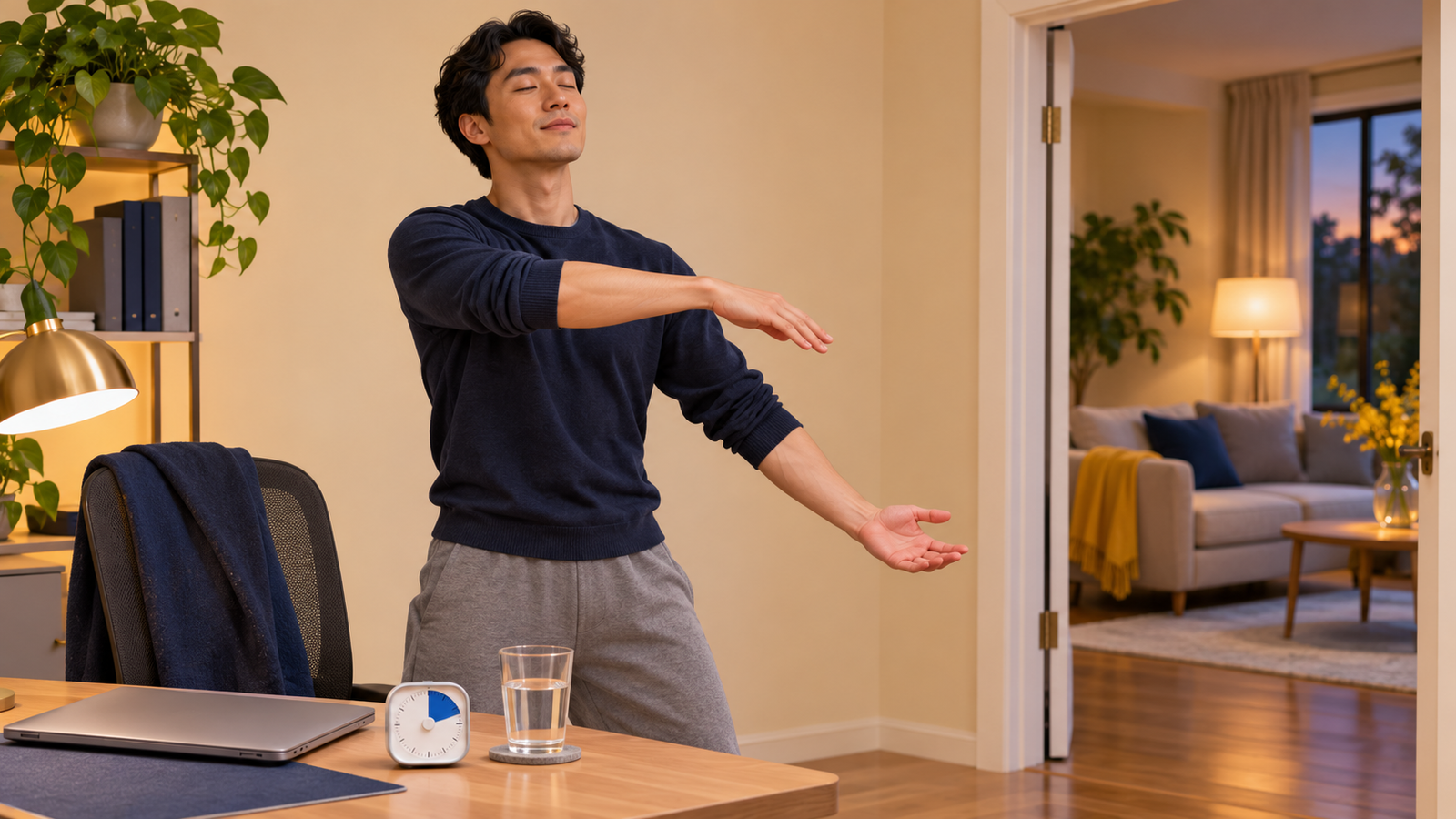
- Settle your stance. Stand with your feet at a
comfortable width and keep the knees soft rather than locked. - Loosen. Gently shake the hands and arms for 20 to
30 seconds. Keep the jaw and shoulders easy. - Swing. Let the arms swing softly from side to side
as the torso rotates within a comfortable range. Do not force the spine,
hips or knees. - Float. Slowly raise the hands in front of the body
to a comfortable height, then let them lower. Repeat at an unhurried
pace. - Pause. Stand still for one or two easy breaths and
notice the contact between your feet and the floor.
You do not have to synchronize every movement perfectly with the
breath. Let breathing remain easy and avoid large, repeated “deep”
breaths if they make you lightheaded.
Qi Gong includes many traditions and forms; this short sequence is
not a complete Qi Gong program. It borrows the practical qualities of
slow movement, relaxed attention and coordinated posture to create a
transition.
Research on Qi Gong and stress is promising but not definitive. A
2024 systematic review included nine randomized trials and found
potential benefits, while also reporting substantial limitations: most
studies were low quality, methods and comparison groups varied, and
dropout was high in several trials. Qi Gong is reasonable to explore as
a gentle wellness practice, but it should not be marketed as a proven
treatment for stress, anxiety or depression. Read the open-access
review: Qigong Therapy
for Stress Management.

Gentle movement can mark a change in role without turning
recovery into another performance goal.
Minutes 6–8: Orient to the
present
Now move attention away from the abstract world of tasks and toward
the environment you are actually in.
Notice:
- three things you can see,
- two sounds you can hear,
- one physical sensation you can feel.
You might notice evening light on the wall, the sound of water in the
sink and the feeling of the floor beneath your feet.
This is a brief mindfulness practice. The aim is not to erase
thoughts. If a work thought returns, acknowledge it and come back to the
next sight, sound or sensation.
If stillness makes you more restless, do the exercise while walking
slowly. Mindfulness does not require a meditation cushion.
Minutes 8–10:
Choose the first part of your evening
The last step is easily overlooked: decide what you are transitioning
toward.
Choose one modest nonwork activity:
- prepare a real meal,
- take a short walk,
- play with your child or pet,
- call a friend,
- shower,
- listen to music,
- read for pleasure,
- work on a hobby,
- sit outside for five minutes.
Choose enjoyment or meaning, not optimization. Your evening does not
need to become a second productivity system.
The LinkedIn outreach research that informed this topic repeatedly
pointed toward a simple question: How can a routine leave room
for things people enjoy? That is a useful editorial hypothesis,
not proof of what any individual needs. The practical answer is to name
the next life-giving activity before work or default scrolling claims
the space.
A three-level version for
real life
The standard ritual takes 10 minutes, but the smaller version is
often what protects consistency.
The three-minute minimum
Use this when the day ends late or you have immediate family
responsibilities:
- Write the next work action.
- Close and put away the device.
- Shake or swing the arms for 30 seconds.
- Name one thing you see, hear and feel.
- Begin one chosen nonwork activity.
The 10-minute standard
Use the complete sequence in this article:
- two minutes of closure,
- one minute of context change,
- three minutes of movement,
- two minutes of mindfulness,
- two minutes to begin personal time deliberately.
The 20-minute outdoor
version
When time and conditions allow, take the ritual outside. Complete the
work-closure step, then walk for 10 to 15 minutes without work audio or
messages. Let the first few minutes be unstructured. Notice light,
temperature, sound and the pace of your steps.
The walk does not need to become exercise. The purpose is
transition.
Adapt the ritual to your
work setting
If you work from home
Remote work needs a visible ending because there may be no commute or
building exit.
- Store the laptop rather than leaving it open in the room.
- Use a separate browser profile for personal use.
- Change the light or music when work ends.
- Walk around the block before re-entering your home in “personal”
mode.
If you work in an office
Use the final five minutes before departure for closure instead of
beginning the ritual in traffic.
- Write the next action before leaving your desk.
- Turn off work notifications unless you have a defined
responsibility. - Use the first part of the commute without work calls.
- When you arrive home, take one minute to move and orient before
entering the evening.
If you manage people
Your behavior can make detachment easier or harder for other
people.
- Avoid sending routine messages after hours when they can wait.
- Use scheduled delivery when you work at unusual times.
- Clarify which channels are genuinely urgent.
- Do not praise constant availability as commitment.
- Ask employees how communication norms affect the way they actually
work.
An individual ritual is useful, but leaders also influence whether
employees are allowed to recover.
What this ritual cannot fix
A transition practice should not become a way to place responsibility
for chronic work problems on the worker.
The National Institute for Occupational Safety and Health recommends
beginning with organizational and environmental conditions when
supporting worker well-being. Its Total Worker Health hierarchy
prioritizes eliminating, substituting or redesigning harmful conditions
before relying on education or individual behavior change. That can mean
addressing workload, staffing, schedule control, communication norms and
job design. See the current NIOSH Total Worker
Health hierarchy.
In practical terms:
- Three minutes of Qi Gong cannot correct chronic understaffing.
- Mindfulness cannot make harassment acceptable.
- A walk cannot replace reasonable workload and time off.
- Better boundaries require both personal actions and organizational
support.
Use this ritual as a supportive practice, not evidence that the
system is fine.
For related Origins Unity guidance, read Do
You Deal With Stress by Avoiding and Ignoring It? and How
to Regulate Your Nervous System Naturally: A Beginner’s Guide. For
organizations, Breathwork
for Workplace Stress and Focus explains why a wellness practice
should remain one part of a wider workplace strategy.
Try it as a seven-day
experiment
Do not judge the ritual after one unusually difficult evening. Try a
consistent version for seven workdays and keep the review simple.
At the end of each evening, note:
- Did I complete the ritual? Yes, partly or no.
- How long did work stay active in my mind?
- Which step helped most?
- What made the transition harder?
- What did I make room for afterward?
You are not trying to prove that the ritual “works” in a clinical
sense. You are learning whether this specific sequence makes your
evening easier to enter.
If 10 minutes feels unrealistic, reduce it. If the movement feels
forced, choose a walk. If silence leads to more rumination, use music or
a conversation. A good ritual is recognizable and repeatable, not
impressive.

The point of leaving work mode is to return attention to the life
waiting outside it.
When more support may be
appropriate
Difficulty switching off can be a normal response to a demanding
period. It can also be part of a larger pattern involving anxiety,
depression, insomnia, burnout, unsafe working conditions or ongoing
conflict.
Consider professional support when distress is persistent, worsening
or disrupting sleep, relationships, daily functioning or safety. A
qualified medical or mental-health professional can help evaluate
concerns that fall outside wellness coaching. Workplace problems
involving harassment, discrimination, safety or labor rights may also
require appropriate organizational, legal or regulatory support.
This article provides general wellness education. It does not
diagnose or treat a health condition.
Frequently asked questions
How long should an
after-work routine take?
Long enough to be noticeable and short enough to repeat. Ten minutes
is a useful starting point, but a consistent three-minute transition can
be more valuable than an elaborate routine you rarely use.
What if I still
think about work afterward?
The goal is not to eliminate every work thought. Capture the next
action, recognize the thought when it returns and redirect attention to
what you chose to do. If the same issue repeatedly dominates the
evening, it may need a work-level solution rather than a stronger
relaxation technique.
Is Qi Gong proven to reduce
stress?
Current research suggests potential benefits, but the evidence is
limited by small samples, varied programs and generally low study
quality. Qi Gong can be explored as a gentle movement and attention
practice; it should not be presented as a proven medical treatment.
Is this the same as
a nervous-system reset?
No single ritual literally resets the nervous system. The sequence
may support a shift in attention, posture, activity and context.
“Transition” is a more accurate description than “reset.”
Can I do
the ritual if I have pain or limited mobility?
Adapt or skip the movement. You can perform small arm movements while
seated, take a comfortable walk or focus on closure and sensory
orientation. Persistent pain, dizziness, balance problems or other
concerning symptoms should be discussed with an appropriate healthcare
professional.
What
if my company expects me to answer messages at night?
Clarify the expectation if it is safe to do so: what counts as
urgent, who is responsible and which channel should be used. A personal
routine cannot substitute for clear workload and communication policies.
Leaders should address the organizational conditions that prevent
recovery.

A calmer
ending creates room for a fuller evening
The workday does not always end when the screen goes dark. Sometimes
it needs a bridge.
Close one loop. Change the scene. Move gently. Notice where you are.
Choose what comes next.
That is enough for a beginning.
If you want a broader approach to strength, energy, nutrition and
recovery that fits a demanding professional schedule, explore Fatigue
to Fit. For organizations looking to support recovery without
placing the whole burden on employees, learn about Origins
Unity corporate wellness programs.