
Most people use flexibility and mobility as if they’re the same thing. But, they’re not. And knowing the difference is one of the fastest ways to improve performance, reduce pain, and build a healthier relationship with your body.
At Origins Unity, we teach that mobility is not just a physical attribute – it’s a mind-body skill that integrates breathing, joint health, posture, nervous system regulation, and functional strength. This is also why many clients choose our fitness program seattle to support their long-term mobility and strength goals.
Let’s break it down.
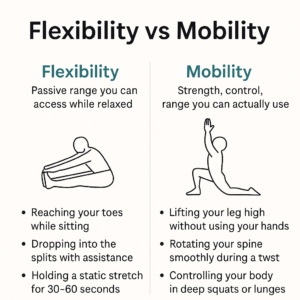
Mobility is your active, usable range of motion: the space your joints can move through with control without external support.
Mobility requires:
Joint health
Stability
Strength through range
Nervous system confidence
Breath support
Coordinated movement
This is why mobility helps you:
✔ Move without pain
✔ Build better posture
✔ Perform in sports
✔ Feel more energized and grounded
✔ Stay resilient as you age
✔ Prevent chronic injuries
Examples of mobility:
Lifting your leg high without using your hands
Rotating your spine smoothly during a twist
Controlling your body in deep squats or lunges
Moving through ranges that require strength, not stretch
Mobility is movement you can rely on.
Flexibility is the length of your muscles and tissues when an outside force helps you stretch -gravity, a strap, a yoga pose, or someone pushing you deeper.
You can be very flexible while still feeling stiff, unstable, or easily injured.
Because flexibility is passive, it doesn’t guarantee that your nervous system or joints feel safe using that range in real life.
Examples of flexibility:
Reaching your toes while sitting
Dropping into the splits with assistance
Holding a static stretch for 30–60 seconds
Flexibility is the potential for movement but not movement itself.
Many people stretch constantly yet still feel:
Tight
Sore
Weak
Stiff when they wake up
Limited in hips, shoulders, or spine
Vulnerable to injury
That’s because stretching alone doesn’t create mobility.
If the nervous system feels unsafe, it restricts movement, no matter how much you stretch.
This is where holistic fitness becomes essential.
Our methodology blends:
To unlock the ranges your nervous system restricts.
To strengthen the joints, tendons, and tissues that make range usable.
To build stability so your body trusts the new ranges.
Because how you feel in your body is as important as how you move it.
You don’t just gain mobility, you also learn to live in it.
This is why Origins Unity clients gain mobility that feels:
Strong
Pain-free
Stable
Energized
Natural in everyday movement
Not just flexible… but capable.
Flexibility is how far you can stretch.
Mobility is how well you can move.
Flexibility is passive.
Mobility is active, alive, and deeply connected to your nervous system.
And when mobility improves, everything improves:
your posture, your energy, your athleticism, your mood, and your long-term health.
This is the heart of holistic fitness.
This is the Origins Unity way.

Origins Unity LLC Gym Yoga Studio Meditation Center offers Holistic Health and Wellness Coaching, Corporate Wellness Programming, and more. We are Mental Health Advocates and aim to produce wellbeing through natural means. Our services are for individuals, groups, and companies.