
Artificial intelligence is supposed to give us time back.
Sometimes it does. A first draft arrives faster. A meeting becomes a
summary. A routine analysis that once took an hour may take minutes.
But I think leaders need to ask a second question: What
happens to the time that AI saves?
If the answer is “we add more tasks, expect faster replies, widen
each person’s role, and keep every old process,” then AI has not reduced
the burden of work. It has increased its density.
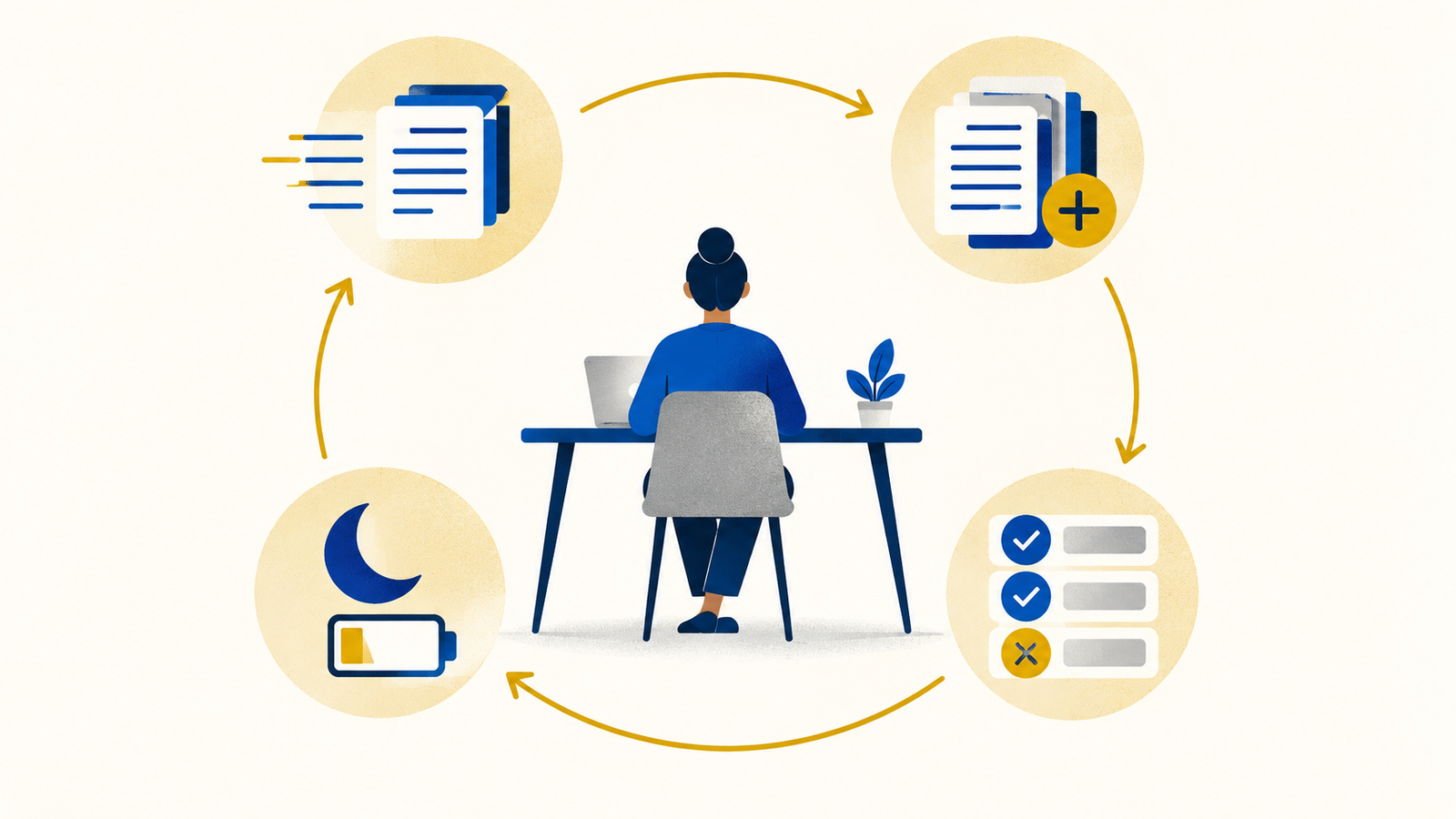
That is AI workload creep: the quiet expansion of volume, scope,
review, and availability after a tool makes individual tasks faster. It
can look like productivity on a dashboard while feeling like chronic
acceleration inside the human nervous system.
As a corporate wellness consultant and coach to technology
professionals, I regularly see the physical side of knowledge work:
shallow breathing, long periods of sitting, poor sleep, evening
overeating, inconsistent training, and a mind that remains at work long
after the laptop closes. AI did not create these conditions. But without
thoughtful job design, it can intensify them.
Does
AI reduce workload—or compress more work into the day?
Research discussed by UC Berkeley scholars Aruna Ranganathan and
Xingqi Maggie Ye followed generative-AI use for eight months at a
roughly 200-person technology company. Their central conclusion was not
that AI failed. Employees worked faster and took on broader tasks—but
work also spread into more hours and became more intense. Their February
9, 2026 analysis describes a pattern in which efficiency gains
encouraged workers to do more rather than stop sooner. Harvard
Business Review
This is important because task speed and workload are different
variables.
- Task efficiency asks how quickly a person can
complete a defined unit of work. - Workload includes how many tasks arrive, how
complex they are, how often priorities change, and how much checking and
coordination they require. - Work intensity describes the pace and concentration
of effort demanded during the available time. - Recovery is the opportunity to come down from that
demand and restore physical and cognitive capacity.
AI can improve the first variable while worsening the other
three.
The hidden work created by
AI
AI output is not automatically finished work. Someone still has to
decide whether it is accurate, appropriate, secure, useful, and aligned
with the larger objective.
That creates forms of labor that organizations may not count:
Verification labor
Employees must check facts, calculations, citations, tone,
assumptions, privacy risks, and hallucinations. Faster generation can
mean more material to inspect.
Integration labor
A useful output still has to fit the company’s systems, standards,
customer context, and decision process. This work often requires
experienced human judgment.
Prompt and tool-management
labor
Workers learn changing interfaces, maintain context across tools,
troubleshoot failures, and decide which model or workflow is
appropriate.
Accountability labor
When an AI-assisted result is wrong, a person still owns the
consequence. Employees may therefore feel pressure to move at machine
speed while remaining fully accountable for human-quality judgment.
Emotional labor
People are not only learning tools. Some are also wondering whether
visible AI adoption will protect their careers—or make their roles
easier to eliminate.
The American Psychological Association found in its 2024 Work in
America survey that 35% of workers intentionally used AI at least
monthly, yet only 18% knew their employer had an official acceptable-use
policy. Forty-one percent worried that AI could eventually make some or
all of their duties obsolete. These are survey responses, not proof that
AI causes distress, but they show a serious gap between adoption and
organizational clarity. American
Psychological Association
Cognitive
load was already high before AI agents arrived
AI enters a workday that is already fragmented.
Microsoft’s 2025 telemetry analysis found that the highest-volume 20%
of Microsoft 365 users received an average of 275 meetings, emails, or
chat notifications across a day—the equivalent of a ping every two
minutes during an eight-hour workday. This statistic applies to that
high-interruption group, not to every employee, but it illustrates how
little uninterrupted attention some workers have left. Microsoft
WorkLab
NIOSH uses the concept of “cognitive workload debt” to describe what
accumulates when people lack enough mental resources to complete tasks
as they arise or when unfinished work continues to linger. Beyond a
tipping point, cognitive functioning can deteriorate. CDC/NIOSH
Now add AI agents that can generate multiple drafts, reports,
recommendations, or actions at once. The bottleneck moves from
production to attention.
The scarce organizational resource is no longer merely how quickly
people can create. It is how well they can prioritize, evaluate, decide,
coordinate, and recover.
Burnout is not a
personal failure to optimize
The World Health Organization defines burnout as an occupational
phenomenon resulting from chronic workplace stress that has not been
successfully managed. Its dimensions include exhaustion, increased
distance or cynicism toward work, and reduced professional efficacy. World
Health Organization
That definition matters. It keeps us from treating an organizational
design problem as an individual weakness.
Breathwork, movement, meditation, sleep, and nutrition can improve a
person’s capacity to regulate stress and recover. I teach and use these
practices because they are practical. But a breathing exercise cannot
compensate for permanently unrealistic workloads. A wellness program
should not be used to help people tolerate preventable dysfunction.
The right approach is both-and:
- Redesign the conditions creating unnecessary overload.
- Give people credible skills for managing unavoidable demand and
restoring capacity.
In martial arts, efficiency is not endless movement. It is removing
wasted tension so strength and attention are available at the right
moment. Work should be designed with the same intelligence.
What the latest
AI-at-work data actually says
Microsoft’s May 5, 2026 Work Trend Index surveyed 20,000 AI users
across 10 countries and analyzed anonymized Microsoft 365 signals. Only
26% of surveyed AI users said leadership was clearly and consistently
aligned on AI, while 65% feared falling behind if they did not adapt
quickly. Microsoft
2026 Work Trend Index
The same report found that organizational factors—culture, manager
support, and talent practices—accounted for 67% of the modeled
importance associated with reported AI impact, compared with 32% for
individual mindset and behavior. This was an association based largely
on self-reported measures; it does not prove that culture caused AI
value. Still, it is a strong signal that adoption cannot be delegated to
individual employees and solved with tool training alone.
The report also found that psychological safety around
experimentation was associated with higher AI readiness and value.
Again, that is a reported association. The practical lesson is that
people need permission to question outputs, admit uncertainty, report
mistakes, and challenge weak use cases.
Six ways leaders
can prevent AI workload creep
1. Define the
outcome before choosing the tool
Start with the customer, employee, or business outcome. “Use more AI”
is not a performance objective. Reducing time-to-resolution without
lowering quality is.
2. Retire work when
automation saves time
For every AI-enabled workflow, name what will stop, shrink, or happen
less often. If nothing leaves the system, the tool is probably
increasing capacity without reducing burden.
3. Measure the full cost of
output
Track rework, review time, defects, escalations, interruptions, and
after-hours work alongside speed and volume. Ask who absorbs the hidden
labor.
4. Protect human decision
space
Create focus blocks, batch reviews, limit notifications, and clarify
which decisions require human judgment. Faster inputs should not mean
constant inputs.
5. Make questioning
AI psychologically safe
Managers should model verification, share mistakes, and reward people
who identify risk. Employees must be able to say, “This output is not
ready,” without appearing anti-innovation.
6. Build recovery
into the operating system
Encourage brief movement, visual distance from screens, regular
meals, realistic meeting boundaries, and actual disconnection after
work. A two-minute breathing practice can help someone transition
between demanding tasks, but it should sit inside a healthier
workload—not disguise an unhealthy one.
For a deeper look at systems that help busy professionals maintain
energy under pressure, see Holistic
Fitness: The System Smart Professionals Use to Get Fit When Nothing Else
Works and Why
Fitness Matters for Tech Professionals.
A simple AI workload
audit for managers
Ask each team these five questions after 30 days of AI use:
- Which tasks became meaningfully faster?
- What new checking, correction, or coordination work appeared?
- Did expectations or task volume increase?
- Did quality, customer value, and decision speed improve?
- Are people ending the week with more capacity—or less?
Then make one concrete subtraction. Remove a recurring report,
shorten a meeting, reduce an approval layer, or narrow an AI-generated
deliverable.
AI adoption becomes sustainable when efficiency creates room—not
merely a higher ceiling for demand.
The future of work
needs a recovery strategy
I am optimistic about AI. It can remove friction, widen access to
expertise, and help people do work that was previously out of reach.
But faster tools do not automatically create healthier work. Leaders
still decide whether saved time becomes space for better thinking or
permission to demand more.
At Origins Unity, we help organizations connect workplace performance
with the human conditions that sustain it: thoughtful job design, stress
regulation, movement, recovery, psychological safety, and practical
health education.
If your team is adopting AI while facing overload, fatigue, or a loss
of focus, explore
Origins Unity’s corporate wellness programs or contact us to discuss
a practical, evidence-informed workshop for your workforce.
For individual technology professionals who are productive on paper
but depleted in practice, the Fatigue
to Fit program provides a 90-day structure for rebuilding energy,
strength, recovery, and sustainable health habits.
Frequently Asked Questions
Does AI reduce employee
workload?
It can reduce the time required for specific tasks, especially
drafting, summarization, analysis, and routine processing. But total
workload may stay the same or increase if organizations add more tasks,
shorten deadlines, or fail to account for review and integration
work.
What is AI workload creep?
AI workload creep is the gradual expansion of task volume, scope,
oversight, and availability after AI makes parts of work faster. It is a
useful management concept, not a medical diagnosis.
Can AI cause burnout?
Current evidence does not justify a simple claim that AI directly
causes burnout. AI can contribute to conditions associated with
burnout—such as work intensification, uncertainty, after-hours work, and
cognitive overload—depending on how jobs and expectations are
designed.
How should
companies measure AI productivity?
Measure useful outcomes, quality, rework, review time, error rates,
customer impact, decision quality, after-hours work, employee workload,
and recovery—not just output volume or tool usage.
Can corporate
wellness solve AI-related burnout?
Wellness programs can strengthen stress-management and recovery
skills, but they cannot replace reasonable workloads, clear policies,
effective management, and healthy job design. The most credible strategy
addresses both the work system and the individual.
What can
employees do when AI increases their workload?
Document new review or coordination tasks, clarify priorities with a
manager, batch AI checks, protect focus time, set boundaries around
response expectations, and use short recovery practices between
high-demand work periods. Persistent exhaustion or mental-health
concerns deserve professional support.

About David Reveles
David Reveles is the founder of Origins Unity LLC, a corporate
wellness consultant, wellness educator, Oxygen Advantage breath
instructor, mental-health advocate, and lifelong martial artist. He
helps professionals and organizations build sustainable performance
through practical systems for movement, breath, recovery, resilience,
and whole-person health.