
AI meeting assistants can record a conversation, create a transcript,
summarize key points, and produce a list of action items before people
have left the call.
That is genuinely useful.
It can also help an organization become exceptionally efficient at
documenting meetings that should not have happened.
As someone who works across technology, workforce strategy, coaching,
and corporate wellness, I think this is the distinction leaders need to
hold: better meeting notes are not the same as better
meetings.
A summary can reduce administrative effort. It cannot decide whether
the right people were present, whether the discussion had a clear
purpose, whether a decision was actually made, or whether another hour
of attention should have been spent together.
The more easily we can capture meetings, the more deliberately we
need to protect human attention.

AI meeting assistants can support recall and follow-through, but
technology should serve the conversation rather than become its
purpose.
What Is an AI Meeting
Assistant?
An AI meeting assistant is software that may record audio or video,
transcribe speech, identify speakers, generate a summary, extract
decisions, create action items, answer questions about the conversation,
and store the meeting in a searchable archive.
These capabilities can reduce the burden of manual note-taking. They
may help people who missed a meeting understand what happened, support
accessibility, and make follow-through easier.
But they also change the nature of the room.
A spoken conversation that might once have been temporary can become
a persistent record. An informal observation can become searchable. A
rough idea may appear in a polished summary without its hesitation or
context. A task extracted by software can look more settled than it
actually was.
That means an AI meeting assistant is not simply a digital notepad.
It is part recorder, editor, memory system, and workflow engine.
The Real Workplace
Problem Is Meeting Load
The strongest case for AI meeting assistants is often framed as time
savings. If nobody has to take notes, everyone can be more present. If
people can read the recap, perhaps fewer employees need to attend.
Those benefits are possible, but the starting condition matters.
Microsoft reported in June 2025 that half of meetings in its
telemetry occurred during two common focus windows: 9–11 a.m. and 1–3
p.m. It also reported that the most heavily interrupted users received a
meeting, email, or chat notification approximately every two minutes
during core work hours. In its separate global survey, 48% of employees
and 52% of leaders described work as chaotic and fragmented (Microsoft
Work Trend Index, June 17, 2025).
These figures combine Microsoft 365 activity signals with survey
responses. They should not be generalized to every employee. They do
show the size of the coordination problem inside a major workplace
ecosystem.
If the calendar is already overcrowded, adding perfect summaries does
not necessarily return attention to employees. It may simply create
another stream of material to review.
Now the worker has:
- The meeting
- The transcript
- The summary
- The extracted tasks
- The follow-up messages
- The expectation that anyone can “catch up” later
Documentation is valuable. Documentation without subtraction can
become information debt.
What the
Research Says About Meeting Intentionality
One of the most useful recent findings is also a modest one.
At CHI 2026, Microsoft researchers reported a preregistered field
experiment involving 361 employees and 7,196 workplace meetings.
Participants in the intervention group received brief prompts to reflect
on meeting goals beforehand. The intervention’s effect on reported
meeting effectiveness was not statistically
significant. Both treatment and control groups did show changes
in self-reported awareness and behavior, possibly because the
post-meeting surveys themselves encouraged reflection (Microsoft
Research/ACM CHI 2026).
That result matters because it resists an easy sales story. Even a
sensible goal-reflection prompt did not automatically make meetings
measurably better.
Meeting quality is social and organizational. It depends on norms,
preparation, authority, participation, facilitation, and what happens
afterward. Technology can support those conditions. It cannot create
them alone.
The practical lesson is not that reflection is useless. It is that
leaders should avoid expecting a lightweight feature to repair a system
whose incentives still reward attendance, visibility, and constant
coordination.
Five Ways AI Notes Can
Create New Work
1. Summary review becomes
another task
Someone still needs to verify names, decisions, owners, deadlines,
and nuances. The more consequential the meeting, the less safely a
summary can be accepted without review.
2. Action-item inflation
AI can identify language that resembles a commitment. It may turn
tentative exploration into an assigned task or detach a statement from
the conditions around it. Teams need a human confirmation step.
3. Searchable memory
expands accountability
Searchable archives can improve continuity. They can also encourage
retrospective scrutiny of informal discussions. Employees may speak less
freely if every unfinished thought is stored indefinitely.
4. Catch-up replaces
protected focus
Allowing someone to skip a meeting is valuable only if the recap is
short, relevant, and consumed within reasonable work time. Otherwise,
the meeting has been converted into asynchronous homework.
5. The meeting becomes
easier to schedule
When organizers assume that AI will handle notes and absentees can
catch up, the threshold for creating a meeting may fall. Convenience can
preserve the habit that caused overload.
Consent Is Part of
Psychological Safety
In May 2026, Google announced an administrator setting that can
require participants to give explicit consent before Google Meet begins
automatic note-taking, recording, or transcription. The setting is off
by default and must be enabled by administrators (Google
Workspace update, May 5, 2026).
This is a product capability, not evidence that consent problems have
been solved.
Meaningful consent requires more than a dialog box. People need to
understand:
- What is being captured
- Why it is being captured
- Where the data will be stored
- Who can access or search it
- How long it will be retained
- Whether the vendor can use it for model improvement
- Whether declining will carry a professional cost
Legal analysis published by Holland & Knight in August 2026 notes
that meeting assistants can convert sensitive discussions—such as HR
matters, legal advice, product strategy, customer information, and
incident response—into transcripts, speaker-attributed records, and
third-party-hosted archives. The analysis recommends examining data use,
retention, access, training rights, subprocessors, notices, and consent
(Holland
& Knight, August 26, 2026).
Organizations should obtain advice appropriate to their jurisdictions
and circumstances. From a culture perspective, the broader principle is
straightforward: employees should not have to choose between
participating in their work and surrendering control over sensitive
speech they did not expect to become permanent.
The Origins Unity Meeting
Value Test
Before inviting an AI assistant, I recommend deciding whether the
meeting deserves to exist.

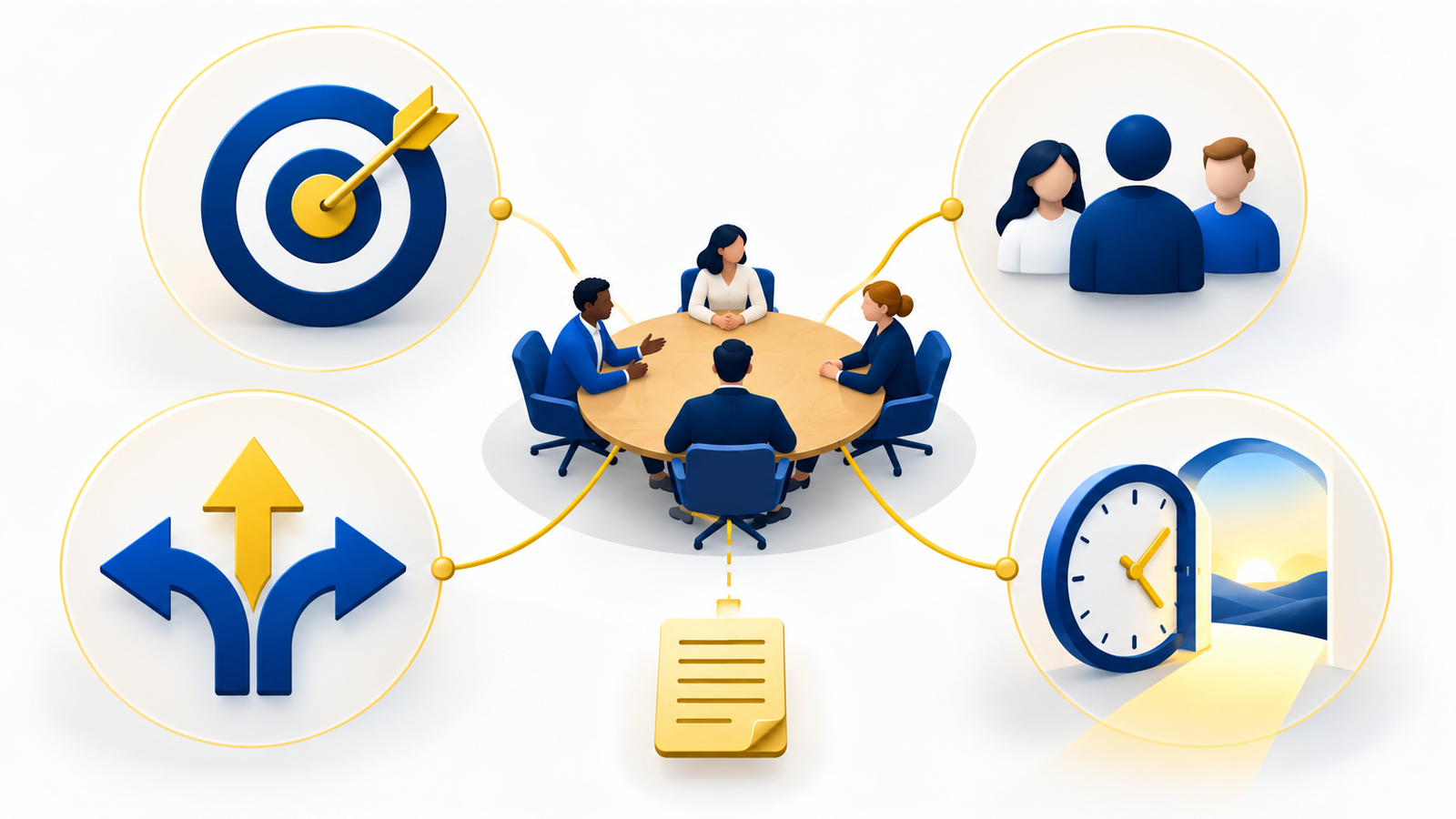
The Meeting Value Test begins with purpose, essential
participation, a real decision, and protected focus—not with the
note-taking tool.
1. Purpose: Why must
people be together?
Write one sentence that explains why synchronous interaction is
necessary. Good reasons include resolving ambiguity, making a contested
decision, generating ideas through exchange, or navigating a sensitive
human issue.
If the purpose is simply to deliver information, use an asynchronous
format.
2. Participation: Who must
contribute?
Invite people who will decide, contribute necessary expertise, or be
directly affected. Do not use attendance as a substitute for
transparency. A concise update can keep stakeholders informed without
taking their attention.
3. Decision: What
should be different afterward?
Name the decision, commitment, learning outcome, or next state the
meeting should produce. If success cannot be described, the meeting is
probably premature.
4. Protection:
What attention will be returned?
If AI notes allow three people to skip the meeting, protect the time
they regain. Do not immediately refill it with another call. The value
appears when that capacity becomes deep work, thoughtful communication,
recovery, or a shorter workday.
5. Record: What
should—and should not—persist?
Decide whether the meeting needs a transcript, a summary, a decision
log, or no recording at all. Collect the minimum useful record. More
data is not automatically better organizational memory.
A Responsible AI Meeting
Policy
Create three meeting
categories
Green: Routine, low-sensitivity meetings where
approved AI notes are permitted.
Yellow: Meetings that require an explicit host
decision and participant notice because they may include customer,
personnel, financial, strategic, or health information.
Red: Meetings where AI recording or transcription is
prohibited, such as certain legal, disciplinary, crisis, confidential,
or highly personal conversations.
The exact categories should be developed with legal, privacy,
security, HR, and employee input.
Assign a human record owner
The host or designated owner should confirm the summary, decisions,
owners, and deadlines. The AI draft should not silently become the
official record.
Set a retention limit
Keep the minimum record for a defined purpose and period. A decision
log may be more useful than a full transcript. Automatic deletion can
reduce data exposure and discourage indiscriminate archives.
Separate
participation analytics from performance evaluation
Speaking time, tone, sentiment, interruption counts, and similar
proxies can be misleading. Do not allow a convenience tool to become an
unexamined employee-monitoring system.
Give people a respected
alternative
If a participant objects, offer a no-recording meeting, a
human-written decision note, or another appropriate format. An opt-out
that harms the person’s ability to participate is not psychologically
safe.
Design Meetings Around
Human Performance
Meetings have a physical and cognitive cost. People transition into
the conversation, regulate social cues, hold multiple perspectives, make
decisions, and then transition back into focused work.
That transition is not wasted time. It is part of the work.
As an Oxygen Advantage breath instructor and lifelong martial artist,
I have learned that attention changes states. We do not move instantly
from conflict, performance, or rapid exchange into deep concentration. A
short pause can help, but it should support good work design—not
compensate for a calendar that ignores human limits.
Origins Unity’s guide to breathwork
for workplace stress and focus explains this distinction: a
breathing practice may help someone transition, but it cannot fix
excessive workload, unclear roles, or poor management.
Leaders can support better transitions by:
- Ending meetings five or ten minutes before the hour
- Protecting blocks without meetings
- Avoiding back-to-back high-stakes conversations
- Closing with confirmed decisions rather than vague discussion
- Sending only the section of a recap each person needs
- Creating a clear end to after-hours meeting follow-up

The benefit of AI meeting support appears when saved attention
becomes meaningful work or recovery—not another layer of
coordination.
A 30-Day Meeting Reset
Week 1: Audit
- Count meetings, participant hours, and after-hours calls.
- Identify meetings without a stated purpose or decision.
- Survey employees about useful, redundant, and sensitive
meetings. - List every AI meeting assistant currently entering company
calls.
Week 2: Govern
- Approve specific tools and configurations.
- Define green, yellow, and red meeting categories.
- Set consent, access, retention, and deletion rules.
- Name who verifies AI-generated records.
Week 3: Subtract
- Cancel or shorten recurring meetings that no longer earn their
cost. - Replace information-only meetings with concise updates.
- Reduce invitations to essential participants.
- Protect the focus time recovered.
Week 4: Measure
Track more than summaries generated. Measure:
- Total participant hours
- Percentage of meetings with a stated purpose
- Decisions reached
- Action items confirmed by a human
- Summary correction rates
- Time spent reviewing recaps
- Employee ability to focus and disconnect
- Sensitive-data or consent incidents
The goal is not the highest use of AI meeting assistants. It is a
healthier communication system.
Frequently Asked Questions
Do AI meeting
assistants improve productivity?
They can reduce manual note-taking and make recaps easier to produce.
Whether productivity improves depends on meeting quality, summary
accuracy, review time, attendance reduction, privacy controls, and
whether saved time is actually protected.
Can AI
meeting assistants reduce meeting overload?
Only if organizations use them to reduce attendance, shorten
meetings, or replace appropriate meetings with asynchronous updates.
Generating notes without subtracting work may add another information
stream.
Are AI meeting notes
accurate?
Accuracy varies with audio quality, accents, technical language,
overlapping speech, and model performance. A human should verify
consequential decisions, responsibilities, and deadlines.
Should every meeting be
transcribed?
No. Organizations should consider purpose, sensitivity, consent,
retention, and data minimization. Some meetings may need only a brief
decision log; others should not be recorded.
What should an AI
meeting policy include?
Approved tools, prohibited uses, meeting categories, participant
notice and consent, data access, retention and deletion, human
verification, sensitive-meeting rules, incident procedures, and employee
alternatives.
How can managers
make meetings less exhausting?
Clarify purpose, reduce attendance, shorten duration, protect focus
blocks, avoid unnecessary back-to-back calls, confirm decisions, and
create transition time. Individual regulation practices may help, but
structural meeting design matters most.
Better Notes
Should Lead to Fewer, Better Meetings
AI meeting assistants can be valuable. I would not reject them simply
because they introduce risk.
I would ask them to earn their place.
If the tool creates a useful record, reduces attendance, improves
follow-through, and returns attention to people, it is serving the
organization. If it merely creates more content around an already
overloaded calendar, the company has automated the symptom.
At Origins Unity, we help organizations connect communication,
workload, stress, recovery, and leadership through a human-centered
approach to performance. Our corporate
wellness programs can support leaders building healthier meeting
rhythms and more sustainable ways of working.
For related guidance, see Ways
to Improve Occupational Wellness in Your Organization, Human
First, Employee Second, and Leadership
and Self-Mastery.

About David Reveles
David Reveles is the founder of Origins Unity, a corporate wellness
consultant, technology and workforce-strategy professional, wellness
educator, coach of technology professionals, Oxygen Advantage breath
instructor, mental-health advocate, and lifelong martial artist. His
work helps people and organizations connect health, leadership, and
sustainable human performance with the realities of modern work.