
AI can help us draft, summarize, analyze, code, and make decisions
faster. That is real value. But there is a question leaders cannot
answer with adoption rates or time-saved estimates alone:
Are people becoming more capable with AI—or simply more
dependent on it?
Those are not the same outcome.
As someone who has worked across technology, workforce strategy,
coaching, and corporate wellness, I do not see this as a choice between
embracing AI and protecting human capability. We need both. The
opportunity is to design AI-assisted work so the tool improves the
result while the person continues to practice the judgment behind
it.
That distinction matters because immediate performance can hide a
learning problem. A person may complete a task more accurately with
assistance and still be less prepared to handle the next unfamiliar
problem without it.
The emerging evidence does not justify panic. It does justify better
job design.
What
the evidence actually says about AI and critical thinking
The strongest conclusion available today is narrower than many
headlines suggest: AI can change where people apply cognitive effort,
and certain forms of dependence may weaken unaided performance in
particular tasks.
Knowledge
workers report shifting—not eliminating—critical thinking
A 2025 Microsoft Research and Carnegie Mellon study surveyed 319
knowledge workers and collected 936 examples of generative-AI use at
work. Greater confidence in AI was associated with less reported
critical-thinking effort; greater confidence in one’s own ability was
associated with more. Participants also described their thinking
shifting toward verification, integration, and oversight. The
researchers did not run a longitudinal skills test, so this is an
association based on self-reports—not proof that AI caused lasting
cognitive decline. Microsoft
Research, April 2025
That shift is important. When AI creates a first draft, our
responsibility does not disappear. It moves from producing every word or
step to assessing whether the output is relevant, well-supported, safe,
and useful.
The risk is that verification can become superficial. A polished
answer feels complete. Familiar language feels credible. Under time
pressure, it becomes easy to accept rather than examine.
Better
assisted performance did not produce better unaided performance
A month-long study accepted for CHI 2026 followed 67 participants who
judged whether news headline-and-image pairs were real or false. AI
assistance improved accuracy during assisted sessions by an average of
21%. Yet by week four, participants’ unaided performance on new items
was 15.3% lower than at the start. Rani and colleagues, revised
March 13, 2026
This is consequential, but it needs boundaries. The sample was small,
the task involved misinformation discernment, and the study lasted one
month. It does not establish that AI weakens every professional skill or
that the change is permanent.
It does illustrate a principle leaders should take seriously:
Assistance can improve the score while the tool is present without
building the skill needed when the tool is gone.
Employers still value
analytical thinking
The World Economic Forum’s Future of Jobs Report 2025
reflects the expectations of more than 1,000 employers representing over
14 million workers. Seven in ten surveyed companies identified
analytical thinking as essential, even as AI and big data ranked among
the fastest-growing skills. The same survey estimated that 39% of
workers’ existing skills could change or become outdated by 2030. These
are employer expectations, not measured forecasts, but they reveal the
strategic tension clearly: organizations need more AI capability and
more human judgment at the same time. World
Economic Forum, January 7, 2025
Cognitive
offloading is not automatically bad
We have always used tools to reduce mental effort. Calendars hold
dates. Spreadsheets perform calculations. Search engines retrieve
information. Good tools free attention for higher-value work.
AI can do that too.
The problem begins when we offload the parts of a task that build the
very capability we still expect people to possess. If a junior analyst
never frames the problem, a manager never interrogates the assumptions,
or a developer never traces why the code works, speed today can create
fragility tomorrow.
This is especially relevant when:
- the decision is high stakes;
- the situation is novel or ambiguous;
- the output affects people’s health, livelihood, privacy, or
opportunity; - the evidence is incomplete;
- the employee is still developing foundational skill; or
- the organization needs someone to recognize when the system is
wrong.
AI literacy should therefore include more than prompting. It should
include knowing when to slow down, what to verify, how to identify
uncertainty, and when not to delegate judgment.
The hidden
organizational costs of skill atrophy
Skill atrophy rarely appears as a clean line on a dashboard. Its
effects surface elsewhere.
Weak problem framing
AI can answer the question it receives. It cannot guarantee that the
organization asked the right question. If employees begin with a prompt
before developing their own view of the problem, the tool can accelerate
work in the wrong direction.
Shallow verification
Verification is a professional skill, not a checkbox. It requires
enough subject knowledge to notice omissions, misleading comparisons,
weak assumptions, and confident errors. People cannot reliably supervise
work they no longer understand.
A thinner talent pipeline
Entry-level work often looks repetitive, but it can also teach
pattern recognition, standards, context, and professional judgment.
Automating all of it without redesigning apprenticeship may remove the
practice through which future experts are formed.
Lower confidence without the
tool
When people rarely complete a task unaided, they may become less
willing to trust their own reasoning. That can create a cycle: lower
confidence leads to more delegation, which creates fewer opportunities
to practice, which further lowers confidence.
More pressure on
experienced reviewers
If AI increases the volume of work while fewer employees can
independently evaluate it, the review burden concentrates on senior
staff. What appears to be democratized capability can become a new
bottleneck.
A
human judgment loop for using AI without losing the skill
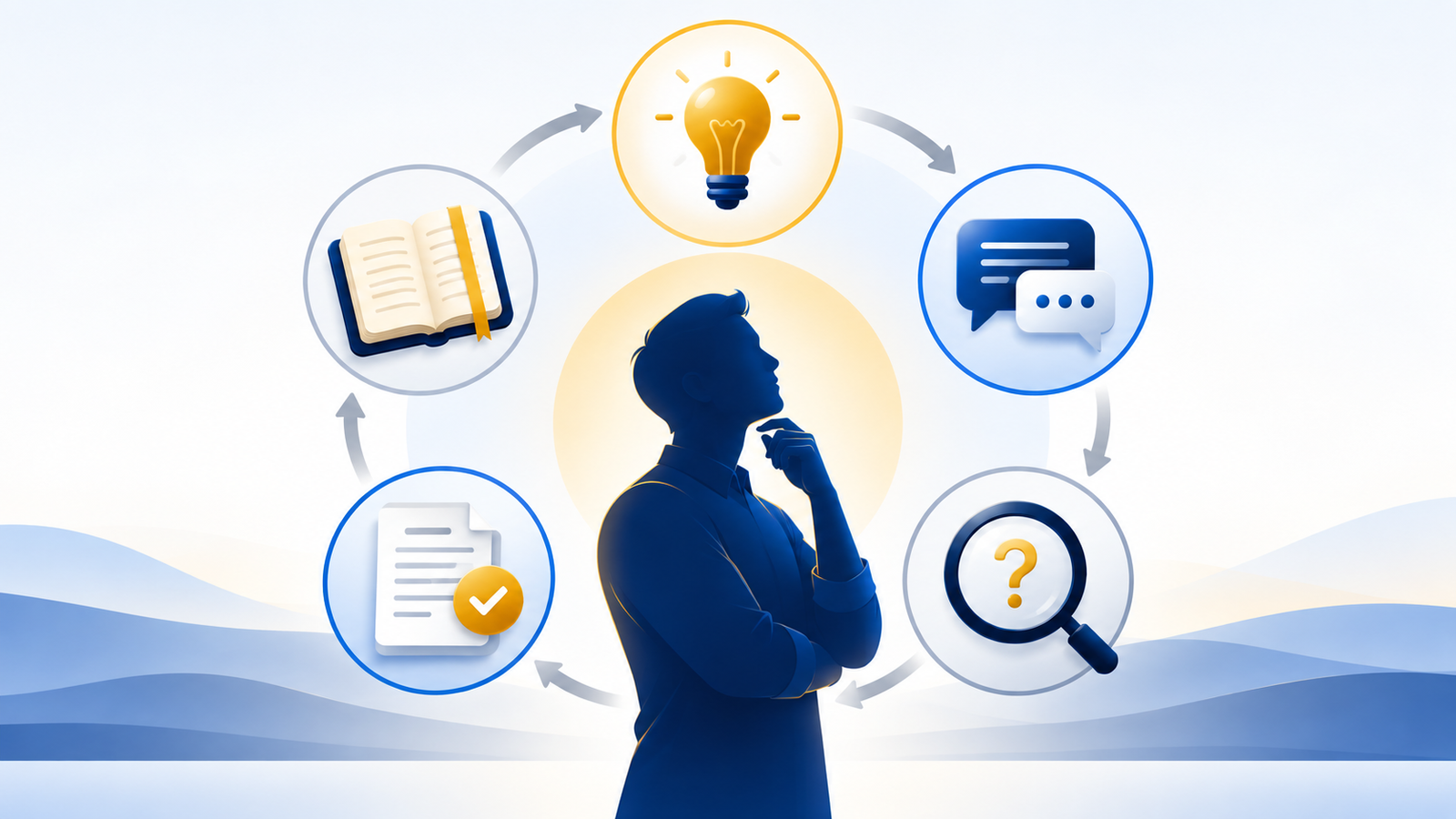
I recommend a six-part workflow for work where judgment matters.
1. Frame
Define the decision, audience, constraints, and standard of evidence
before opening the AI tool. Ask: What are we actually trying to
understand or decide?
2. Attempt
Create a brief independent view first. It may be an outline,
hypothesis, calculation, risk list, or rough solution. The purpose is
not to avoid AI. It is to preserve original reasoning and make later
comparison possible.
3. Assist
Use AI where it adds leverage: generating alternatives, testing
structure, summarizing supplied material, identifying missing
considerations, or accelerating a draft.
4. Challenge
Do not ask only for confirmation. Ask the system to identify
counterarguments, assumptions, failure modes, and evidence that would
change the recommendation. Then have a person challenge those responses
as well.
5. Verify
Check consequential claims against primary sources. Confirm
calculations. Review for privacy, bias, security, and context. Assign a
named human owner for the final decision.
6. Reflect
After the work is complete, ask what the team learned, what the AI
missed, and what capability should be retained. Reflection turns an
assisted task into a learning opportunity.
This is the core principle: AI may help produce the first
draft. A person must still own the last judgment.
Seven practices
leaders can put into place now
1. Classify tasks by
learning and risk
Not every task needs the same level of human effort. Separate work
into categories:
- low-risk routine work that can be heavily automated;
- developmental work where employees need meaningful practice;
- high-stakes work requiring documented human review; and
- core capabilities the organization must be able to perform without a
specific tool.
This prevents one AI policy from being applied to every kind of
work.
2. Protect “think first” time
For important decisions, give employees a few minutes to form an
independent view before seeing an AI recommendation. This reduces
anchoring and preserves the habit of framing problems.
3. Use AI as a sparring
partner
My background in martial arts shapes how I think about this. A useful
training partner provides enough resistance to help you improve. A
partner who performs the movement for you may make the session feel
easier, but you do not build the same capability.
AI can be used to ask sharper questions, present opposing arguments,
or simulate difficult scenarios. That builds more judgment than asking
it to make every decision.
4. Preserve
no-AI practice for essential skills
Teams need occasional unaided repetitions of the capabilities they
cannot afford to lose. That may include writing a short analysis,
debugging a problem, explaining a recommendation, estimating a risk, or
responding to an incident.
This is not punishment or nostalgia. It is resilience testing.
5.
Redesign apprenticeship before automating junior work
If AI removes entry-level tasks, replace the learning function
intentionally. Use shadowing, supervised review, scenario practice,
rotation, and explanation-based assignments. Ask junior employees not
only for an output, but for the reasoning that supports it.
6. Create
psychological safety around uncertainty
Employees should be able to say, “I do not understand why the AI
produced this,” or “I think this recommendation is wrong,” without being
labeled resistant or inefficient. Human oversight fails when people feel
pressure to agree with the system.
This connects to a broader principle of human-centered leadership:
people need enough trust to question, learn, and speak honestly. They
also need the attention to do it. Short regulation practices can support
focus, but they should complement sound job design rather than
compensate for it. Origins Unity explores that distinction in our guide
to breathwork
for workplace stress and focus.
7. Measure
retained capability, not adoption alone
Add measures that show whether the organization is learning:
- quality and correction rates;
- ability to explain the reasoning behind a decision;
- performance on unfamiliar problems;
- unaided capability for critical tasks;
- escalation quality;
- confidence calibrated to actual accuracy;
- learning progression for junior employees; and
- employee cognitive load and recovery.
AI usage is an input. It is not proof of capability.
Critical thinking
also depends on human state
We should not treat judgment as if it exists separately from
health.
Tired, overloaded people are more likely to reach for the fastest
acceptable answer. They have less capacity to hold competing
possibilities, notice subtle inconsistencies, and tolerate the
discomfort of uncertainty. AI may become more tempting precisely when
thoughtful review is most needed.
That is why responsible AI adoption is also a human-performance
issue. Leaders need reasonable workloads, recovery, role clarity, and
cultures where careful questions are valued. Individual practices can
help people regulate stress and restore attention, while organizational
design must address the conditions creating overload.
Origins Unity’s corporate
wellness programs connect physical health, stress regulation, mental
resilience, and sustainable performance. For individual professionals
whose energy and focus have eroded under chronic demand, our Fatigue
to Fit program provides a structured path for rebuilding recovery
and resilience.
The
goal is augmented judgment, not automated dependence
I believe AI can make work better. It can reduce friction, broaden
access to expertise, and give people more room for meaningful
contribution.
But capability does not grow simply because output grows.
Leaders have to decide where people should be assisted, where they
should be challenged, and which skills the organization must continue to
practice. The strongest AI strategy will not remove thinking from work.
It will move human thinking toward the questions, tradeoffs, and
decisions that matter most—and then give people the conditions to do
that work well.
AI can support the answer.
Human beings still need to understand the problem, test the evidence,
and own the consequences.
A practical next step
Choose one AI-assisted workflow this week. Ask three questions:
- Which part of this work is faster?
- Which human skill is still essential?
- Where does that skill get practiced and measured?
If the third answer is unclear, the workflow is not finished.
Frequently asked questions
Does AI reduce critical
thinking?
Current evidence does not support a universal claim that AI reduces
critical thinking in every person or task. A survey of knowledge workers
found that greater confidence in AI was associated with less
self-reported critical-thinking effort, while a small task-specific
study found improved assisted performance but lower unaided performance
later. These findings identify a risk worth managing, not a settled
verdict about intelligence.
What is cognitive offloading?
Cognitive offloading means using an external tool to reduce mental
effort, such as a calendar, calculator, search engine, or AI assistant.
It can be beneficial when it frees attention for higher-value work. It
becomes risky when people offload the reasoning they still need to
understand, verify, or perform independently.
How
can employees use AI without losing critical-thinking skills?
Form an independent view before prompting, use AI to generate
alternatives rather than only answers, challenge its assumptions, verify
important claims with primary sources, explain the final reasoning in
your own words, and periodically practice essential tasks without
assistance.
Should companies require
no-AI work?
Not across the board. Limited no-AI practice can be useful for
developmental assignments, capability checks, incident preparation, and
skills the organization must retain. The purpose should be clear and
related to learning or resilience—not surveillance or punishment.
What should
leaders measure beyond AI adoption?
Measure decision quality, error and rework rates, performance on
unfamiliar problems, the ability to explain reasoning, skill
progression, escalation quality, employee cognitive load, and retained
unaided capability for critical tasks.
How does
employee wellbeing affect AI oversight?
Verification and judgment require sustained attention. Chronic
fatigue, overload, and stress can make careful review harder. Workplace
wellbeing therefore supports responsible AI use, although wellness
practices should not substitute for reasonable workloads, clear roles,
and accountable AI governance.
About David Reveles
David Reveles is the founder of Origins Unity, a corporate wellness
consultant, technology and workforce-strategy professional, wellness
educator, and coach to technology professionals. He is also an Oxygen
Advantage breath instructor, mental-health advocate, and lifelong
martial artist. His work connects employee health, human performance,
leadership, and organizational design so people and companies can
perform sustainably as technology changes how work gets done.

Corporate wellness call to
action
AI strategy is often discussed as a technology program. In practice,
it is also a leadership, learning, and human-performance program.
Origins Unity helps organizations strengthen the conditions people
need for sound judgment: sustainable energy, stress regulation,
recovery, trust, and practical resilience. If your team is adopting AI
while navigating cognitive overload, changing roles, or rising
performance expectations, explore our corporate
wellness programs or contact Origins Unity to discuss a program
aligned with your workforce.