
Protein advice often starts with a number.
The harder question is what to do with that number at 7:30 in the
morning, between meetings at lunch, or when dinner needs to happen in 15
minutes.
A useful protein plan should do three things:
- give you a reasonable starting range;
- show you how to reach it with ordinary food; and
- leave room for your health, appetite, preferences, budget and
training.
You do not need to make every meal a calculation. You need a
practical floor: enough structure to keep protein from disappearing when
the week gets crowded.
Quick answer:
protein needs depend on the question
Two numbers currently appear in credible U.S. guidance:
- The longstanding Recommended Dietary Allowance is 0.8 grams
per kilogram of body weight per day for healthy adults. The RDA
is designed to cover the nutrient requirements of nearly all healthy
people in a group.[1] - The 2025–2030 Dietary Guidelines for Americans recommend
1.2–1.6 grams per kilogram per day, adjusted for individual
calorie needs, as part of their current food-first guidance.[2]
Those numbers are not interchangeable.
The RDA is an adequacy reference. The newer Dietary Guidelines
present a higher healthy range for food-pattern guidance. Their
supporting report used a rapid systematic review for adult
weight-management outcomes and a narrative review for nutrient adequacy,
so the range should not be treated as a clinical prescription for every
person.[3]
Age, total energy intake, training, pregnancy, body composition,
medical conditions and the purpose of the plan can all change the
discussion. If you have kidney disease, another condition that affects
protein needs, a history of disordered eating, or a therapeutic
nutrition plan, work with a qualified clinician or registered dietitian
nutritionist before making a large change.
Turn grams per
kilogram into a starting range
If you want to understand the current federal range, the calculation
is simple:
Body weight in pounds ÷ 2.2 = body weight in kilograms
Then:
Body weight in kilograms × 1.2 to 1.6 = daily protein range in
grams
The examples below illustrate the calculation. They are not
individual prescriptions.
| Body weight | Approximate kilograms | 1.2 g/kg | 1.6 g/kg |
|---|---|---|---|
| 120 lb | 54.5 kg | 65 g | 87 g |
| 150 lb | 68.2 kg | 82 g | 109 g |
| 180 lb | 81.8 kg | 98 g | 131 g |
| 210 lb | 95.5 kg | 115 g | 153 g |
A larger number is not automatically better. The point is to choose a
range that fits the purpose and your health, then see whether the food
plan is realistic.
What about active adults?
Sports-nutrition guidance sometimes uses higher ranges for people
training hard, building muscle or dieting while trying to preserve lean
tissue. That does not mean every active adult needs the highest
number.
Training volume, calorie intake, age and goals matter. Start by
meeting a reasonable daily range consistently before treating protein as
a contest.
Build a protein
floor, not a perfect ceiling
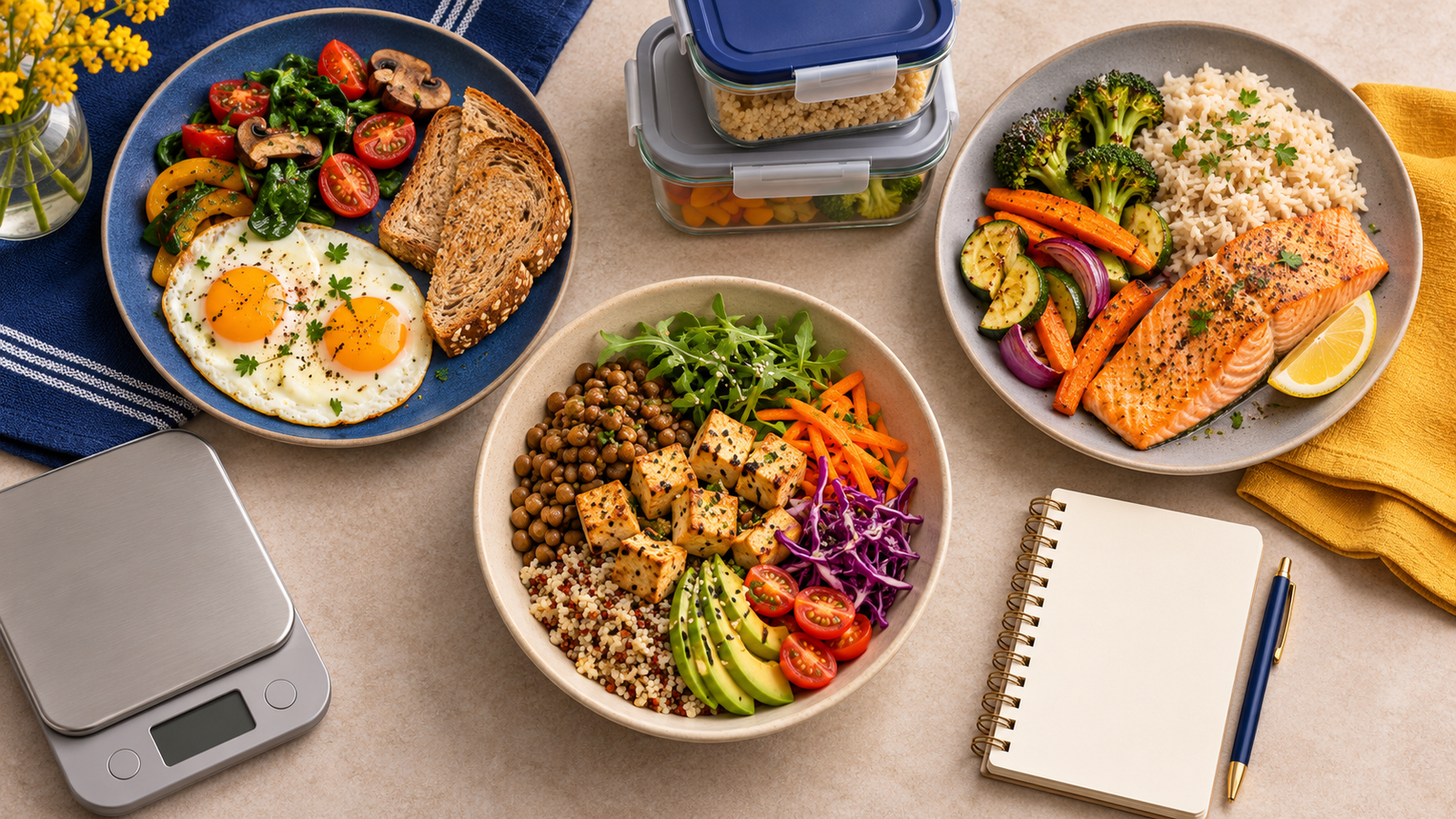
A protein floor is a repeatable minimum structure. It is not a
promise that one number will produce a specific result.
For many people, the easiest approach is:
- Identify the meals that happen most days.
- Give two or three of those meals a clear protein anchor.
- Keep two backup anchors available.
- Check the total occasionally, not automatically forever.
- Adjust when your health, training or appetite changes.
This approach fits alongside the Origins Unity Clock
Method. The clock helps organize the whole meal. The protein floor
helps make sure the protein section is more than a garnish.
What counts as a protein
anchor?
A protein anchor is one food—or a deliberate combination—that
contributes a meaningful share of the meal’s protein.
These estimates reflect typical products and portions. Brands,
preparation methods and serving sizes vary, so use the label or USDA FoodData Central when
precision matters.
| Protein anchor | Typical portion | Approximate protein |
|---|---|---|
| Salmon or tuna | 4 oz cooked | 24–30 g |
| Eggs | 3 large | 18–20 g |
| Plain Greek yogurt | 1 cup | 18–25 g |
| Cottage cheese | 1 cup | 24–28 g |
| Firm tofu | 1 cup | 20–24 g |
| Tempeh | 4 oz | 20–22 g |
| Lentils | 1 cup cooked | About 18 g |
| Edamame | 1 cup cooked | 17–19 g |
| Protein powder | 1 scoop | Commonly 20–30 g; check the label |
The current Dietary Guidelines emphasize variety across animal and
plant protein foods, including eggs, seafood, poultry, beans, peas,
lentils, nuts, seeds and soy.[2] You do not need one “best” source.
Some foods sit in more than one category. Lentils provide protein and
carbohydrate. Salmon provides protein and fat. That is normal. Meals do
not need to fit a spreadsheet perfectly.
Does protein
have to be evenly spread across meals?
No universal per-meal number has been established for everyone.
A 2021 systematic review found some association between a more even
protein distribution and higher muscle mass, but the evidence was
insufficient to conclude that even distribution improves strength or
protein turnover.[4]
Spreading protein across meals can still be practical. It may be
easier to eat three moderate portions than to discover at dinner that
most of the day’s protein is still missing. Treat distribution as an
organizing tool, not a metabolic rule.
A simple distribution
example
Suppose a person’s appropriate target is around 90 grams per day. A
workable pattern could be:
- breakfast: about 20–25 g;
- lunch: about 25–30 g;
- dinner: about 30 g; and
- a snack or the rest of the meal pattern: the remaining amount.
That is an example, not a required schedule. Someone who prefers two
larger meals, has a small appetite, works shifts or follows a clinical
nutrition plan may need a different structure.
Four meals that
use the protein-anchor method
Breakfast: eggs or tofu first
Build a scramble with eggs or tofu, vegetables and toast or potatoes.
If breakfast is small, plain Greek yogurt or a protein-rich soy yogurt
can be easier.
Coffee can stay. It just does not have to be breakfast by itself.
Lunch: make the anchor
visible
For a grain bowl, use a clear portion of salmon, tuna, tofu, tempeh,
edamame or lentils. Add vegetables, rice or quinoa, and a dressing you
enjoy.
If lunch comes from a café, ask a simple question: Where is the
main protein source?
Snack: use it only
when it solves a problem
A snack can close a gap when meals are far apart or appetite is
limited. Options include yogurt, edamame, eggs, a tuna packet, roasted
chickpeas or a shake.
You do not need a snack because a plan says so. Use one when it makes
the day easier.
Dinner: keep the Clock Method
Use the Clock
Method as the full-meal framework: vegetables, a protein anchor,
carbohydrate foods and an appropriate amount of fat already present in
the food or cooking.
The protein anchor is one part of a balanced meal. It should not push
vegetables, fruit, whole grains and other useful foods off the
plate.
The busy-week protein system
The best protein plan is the one that still works when you have less
time.
Choose two ready-to-eat
anchors
Examples:
- plain Greek yogurt or a protein-rich soy yogurt;
- canned tuna or salmon;
- cooked edamame;
- hard-boiled eggs;
- baked tofu or tempeh; or
- a protein powder you tolerate and can verify.
Choose two five-minute
anchors
Examples:
- eggs;
- frozen edamame;
- tofu added to a microwave grain-and-vegetable bowl;
- lentils from a low-sodium can or pouch; or
- leftover salmon.
Choose one dinner anchor
Prepare enough for more than one meal. A tray of salmon or tofu can
become dinner, tomorrow’s lunch and a backup bowl.
Keep the rest of the meal
easy
Frozen vegetables, prewashed greens, fruit, microwave rice, potatoes,
oats and whole-grain bread reduce the number of steps between knowing
what to eat and actually eating it.
This is the same principle behind a good backup-meal system: reduce
the number of decisions required on a crowded day.
A one-week protein-floor
audit
Do this for seven days before rebuilding your entire diet.
| Step | What to do | What to learn |
|---|---|---|
| 1. Choose a range | Use appropriate guidance or your clinician’s target | What are you aiming for? |
| 2. Observe three days | Record meals without trying to make them perfect | Where does protein disappear? |
| 3. Fix one meal | Add or enlarge one protein anchor | Was the change easy to repeat? |
| 4. Add two backups | Keep one ready-to-eat and one five-minute option | Did fewer meals get improvised? |
| 5. Review the week | Check intake, appetite, digestion, training and effort | What one change belongs next? |
Do not change everything at once. If the weak point is breakfast, fix
breakfast. If dinner is already reliable, leave it alone.
If you use a GLP-1
medication
Reduced appetite, food aversions or gastrointestinal symptoms can
make adequate intake harder for some people using GLP-1 medications.
A 2025 joint advisory from four professional organizations recommends
individualized nutrition assessment, attention to nutrient intake,
resistance training where appropriate, and coordination with clinicians.
It also notes that optimal protein targets during GLP-1 therapy remain
uncertain, especially when body size and body composition complicate
gram-per-kilogram calculations.[5]
Practical priorities include:
- tell your prescriber if nausea, vomiting or low intake is
persistent; - ask a registered dietitian nutritionist for an individualized
plan; - choose smaller, tolerable, nutrient-dense meals when large meals are
difficult; - use a protein-rich food early in the meal when that helps; and
- combine adequate nutrition with an appropriate strength-training
plan rather than expecting protein alone to preserve muscle.
Do not change a medication dose based on a nutrition article. The
Origins Unity guide to GLP-1
weight loss, muscle, nutrition and fitness support explains the
boundary between coaching and prescribing care.
When more protein is
not the first answer
Pause and get individualized help when:
- you have kidney disease or have been given a protein
restriction; - pregnancy, a medical condition or a medication changes your
nutrition needs; - low appetite, vomiting, pain or difficulty swallowing interferes
with eating; - food tracking is becoming rigid or distressing;
- you are losing weight unintentionally; or
- fatigue or weakness is persistent and unexplained.
Protein can support a nutrition plan. It does not diagnose or resolve
the cause of a symptom.
Frequently asked questions
Is 0.8 g/kg or
1.2–1.6 g/kg the right protein number?
They come from different guidance. The longstanding RDA of 0.8 g/kg
is an adequacy reference for healthy adults. The 2025–2030 Dietary
Guidelines recommend 1.2–1.6 g/kg as a current healthy range adjusted
for calorie needs. Individual needs still vary, and medical conditions
may call for a different target.
How much protein
should I eat at each meal?
There is no single per-meal number for everyone. Start with your
appropriate daily range, then divide it across the meals you reliably
eat. Spreading protein can make the plan easier, but equal distribution
has not been proven to improve every muscle-related outcome.
Do I need protein powder?
No. Food can meet protein needs for many people. Powder can be a
convenient backup when appetite, time, travel or food preferences make
the plan difficult. Check the label, ingredient list and third-party
testing where relevant.
Can plant foods provide
enough protein?
Yes. Beans, lentils, soy foods, peas, seeds, nuts and grains can
contribute. A varied eating pattern and adequate total intake matter.
Portions and protein density differ, so some people may need more
planning than with a concentrated protein source.
Should
I eat more protein if I am taking semaglutide or tirzepatide?
Do not apply a high target automatically. Appetite, current intake,
body composition, kidney health, treatment goals and side effects
matter. Work with the prescribing team and a registered dietitian
nutritionist when possible. Protein is only one part of preserving
strength and adequate nourishment.
Start with the
meal that needs the most help
Protein guidance is useful when it changes what you do.
Choose the meal where protein is least reliable. Add one food you
enjoy and can keep available. Repeat it for a week. Then decide whether
you need a bigger change.
If you want help building nutrition, movement and recovery around
your actual schedule, Fatigue
to Fit provides personalized lifestyle and fitness coaching for busy
professionals. The first step is understanding your current routine and
deciding what is realistic. Genetic testing is optional and is not
required to build a practical nutrition plan.
This article provides general nutrition and wellness education,
not medical advice or individualized medical nutrition therapy.
References
- National Academies of Sciences, Engineering, and Medicine. Dietary
Reference Intakes tables and definitions. The adult protein RDA is
based on 0.8 g/kg and is intended to cover the requirements of nearly
all healthy adults. - U.S. Department of Health and Human Services and U.S. Department of
Agriculture. Dietary
Guidelines for Americans, 2025–2030. January 2026. The current
edition recommends prioritizing varied protein foods and lists a 1.2–1.6
g/kg/day serving goal adjusted to calorie needs. - U.S. Department of Health and Human Services and U.S. Department of
Agriculture. Scientific
Foundation for the Dietary Guidelines for Americans, 2025–2030:
Appendices. The protein review used a rapid systematic review for
adult weight management and a narrative review for nutrient
adequacy. - Hudson JL, et al. Evenness of Dietary
Protein Distribution Is Associated with Higher Muscle Mass but Not
Muscle Strength or Protein Turnover in Healthy Adults: A Systematic
Review. Journal of Nutrition. 2021;151(3):523–534. The
review found insufficient evidence for several proposed benefits and
does not establish a required meal schedule. - Mozaffarian D, et al. Nutritional Priorities
to Support GLP-1 Therapy for Obesity: A Joint Advisory.
Obesity. 2025;33(8):1475–1503. This is an expert advisory
informed by literature review and clinical experience; it identifies
evidence gaps rather than a universally validated nutrition
protocol.

Author bio
David Reveles is the founder of Origins Unity LLC, a Seattle-based
holistic fitness and wellness company. He holds NASM personal training
certification and credentials in nutrition, breathwork and workplace
wellness, with more than 25 years in fitness, martial arts, movement and
coaching.