
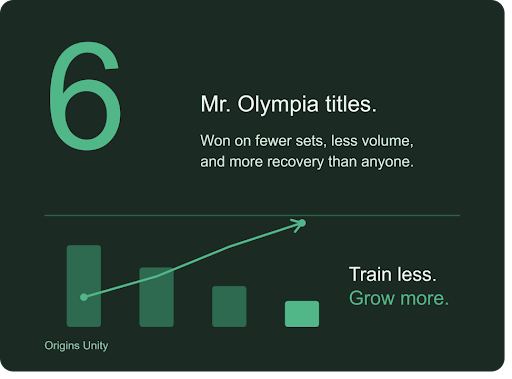
Here’s a fact that breaks people’s brains when I tell them. Dorian Yates won six Mr. Olympia titles in a row using a training method built on doing less, not more. Fewer sets. Less time in the gym. More days off. The Dorian Yates training method stripped bodybuilding down to its rawest form — and it still holds lessons for anyone too exhausted to grind through hour-long sessions.
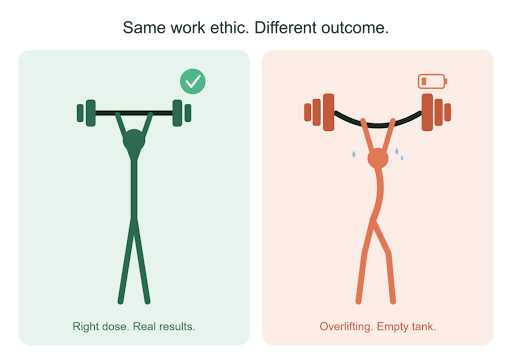
While his competitors were grinding through two-a-days, Yates walked in, did a handful of genuinely brutal sets, wrote down his numbers, and went home. That was the whole strategy. I still think about how simple that is.
I bring this up because most of the people I work with are already running on empty. Senior engineers, tech leads — people carrying a team, a codebase, a family, and somewhere near the bottom of that list, a quiet guilt about not “doing enough” in the gym.
The fitness industry hasn’t done you any favors here. Not by lying outright, but by selling volume. More sets, more sessions, more supplements. It moves products. It just doesn’t build much when you’re already fried — and I’ve watched it burn out more good people than I can count.
Yates figured this out in the 1990s, in an era obsessed with the opposite. Let me walk you through what he actually did, then hand you a version you can run this week without wrecking yourself.
What is the Dorian Yates training method?
Yates trained using a form of High Intensity Training, or HIT: a small number of extremely hard working sets, taken to true muscular failure, followed by a lot of rest.
The logic is almost stubbornly simple. Muscle responds to the intensity of effort, not the amount of work you pile on. One brutally hard set sends the signal. Everything after that isn’t extra stimulus — it’s just extra fatigue eating into the recovery you actually need to grow.
So he made a trade: spend as little volume as possible, and buy the maximum effort with it. Guard recovery like it’s the whole point of the program.
Because in his system, it was. You don’t grow in the gym. You grow after it. The gym is just where you place the order.
The four ideas the whole thing rests on
Strip away the theatrics and the highlight reels, and you’re left with four pillars.
One all-out set does the heavy lifting. After a proper warm-up, most exercises get a single working set taken to real failure — the rep where your form is still clean, but the next one simply isn’t happening. Not “pretty tired.” Empty.
Progression is the engine, not the set count. Yates logged every set, every session, and every session had to beat the last one — a bit more weight, or one more rep. This is the part people skip when they romanticize the “just one hard set” story. One set only works if that set keeps getting harder over time.
Control the weight — don’t throw it. Slow, deliberate reps, no bouncing, no momentum. You’re trying to make the muscle do the work, not relocate a dumbbell from A to B.
Recovery is a training input, not a break from training. Each muscle got hit hard roughly once a week. As his career went on, he trained less, because he trusted recovery to finish what the workout started.
That’s the entire method behind one of the greatest backs the sport has ever seen.
Why the Dorian Yates Training Method Fits Someone Who’s Exhausted
Here’s where I get genuinely excited about this for the people I work with.
Most training advice assumes you’re walking in fresh, motivated, with time to spare. You’re not. You closed a Jira ticket at 11pm. Your nervous system is still buzzing. You’ve maybe got three honest hours a week to give this.
A high-volume program punishes that reality. It demands time you don’t have. It demands recovery you don’t have. Then it makes you feel like you’re failing when you can’t keep pace.
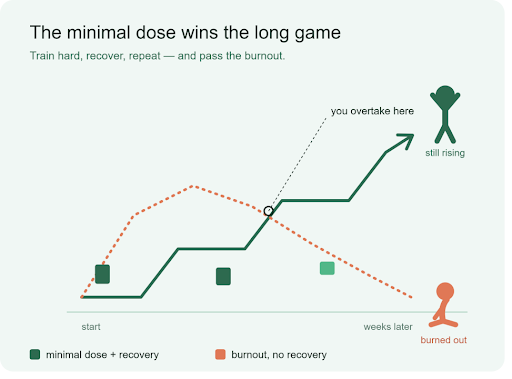
This is exactly where the Dorian Yates training method earns its keep — a minimalist, recovery-first approach that does the opposite. Short sessions. Low total volume. Big rest windows. And because you’re only doing a handful of sets, there’s no room for junk work — every set has to earn its place.
One honest caveat: Yates’ exact method isn’t built for you. His past-failure techniques — forced reps, heavy negatives, grinding well beyond failure — carried real injury risk even for him. Over his career he tore a triceps, a biceps, and a quad. He was also competing at the very top of an openly enhanced era, which changes how much of that intensity anyone else can safely borrow.
So we keep the skeleton. We lose the parts that break people. If you want the full picture of how frequency, intensity, and progression interact, our fitness training variables guide breaks down every dial you can adjust in a program like this.
The Recover-First Template: A Safer Dorian Yates Training Method
Same bones Yates used — low volume, hard effort, obsessive progression, protected recovery — with the injury risk dialed way down for a general or fatigue-prone body.
The one rule change that keeps you safe
Yates trained to, and past, failure. You’re going to train near it.
The tool is Reps In Reserve, or RIR — how many more reps you could squeeze out when you stop.
Most sets: stop with 1–2 reps left in the tank (RIR 1–2). Hard. Not heroic.
The occasional last set of a movement, once you’ve built some confidence: take it to true failure. Rarely, and on purpose.
That one change removes most of the injury risk and almost none of the growth. For anyone who isn’t a professional bodybuilder, that’s the trade of the century.
The weekly structure
Two or three full-body sessions a week. Never back-to-back. That’s the whole calendar.
2 days: Day A and Day B, at least one rest day between them.
3 days: A / B / A one week, B / A / B the next.
Each session: 4–5 exercises, one to two working sets apiece. In and out in 35–45 minutes.
Day A
| Exercise | Warm-ups | Working sets | Effort |
| Leg press or Goblet squat | 2 | 2 | RIR 2 |
| Chest press (machine or DB) | 2 | 2 | RIR 1–2 |
| Seated row | 1 | 2 | RIR 1–2 |
| Shoulder press | 1 | 1 | RIR 1–2 |
| Plank / dead bug | — | 2 | Controlled |
Day B
| Exercise | Warm-ups | Working sets | Effort |
| Romanian deadlift or hip hinge | 2 | 2 | RIR 2 |
| Lat pulldown | 2 | 2 | RIR 1–2 |
| Incline press (machine or DB) | 1 | 2 | RIR 1–2 |
| Split squat or leg curl | 1 | 2 | RIR 2 |
| Face pull / rear delt | 1 | 1 | RIR 2 |
Reps sit in the 8–12 range, which is where the Dorian Yates training method keeps most of its working sets. Control the lowering phase — a slow three-count down, no bouncing. That’s where a lot of the actual work happens, and it lets you use less weight for the same effect. Easier on the joints, just as effective on the muscle. That slow lowering phase isn’t a small detail — it’s worth its own read if you want to understand why control matters more than weight, in our guide to eccentric training.
The part you can’t skip: log everything
Get a notebook. Or a notes app, whatever you’ll actually reopen next week.
Write down every working set — weight and reps. Next session, beat it. One more rep, a little more weight. That’s the entire progression model, and it’s non-negotiable. No log, no program. People quietly drop this piece more than any other, and it’s the one piece the whole thing depends on.
Wrap each session with a downshift
Here’s something Yates never had to think about, because it matters more for you than it did for him.
You’re not just recovering muscle. You’re recovering a nervous system that’s been running hot all day. So don’t slam the laptop shut and dive straight back into Slack.
Give it five minutes. Slow nasal breathing, exhale longer than you inhale. A few minutes of quiet. Let your body register that the hard part is over and it’s safe to start rebuilding.
This isn’t a wellness add-on. You grow in a recovered, calm state — not a wired one. Five minutes of breathwork after training may be the highest-return five minutes of your whole week.
How to progress over 90 days
Same idea Yates used — earn the right to push harder — restructured for a nervous system that’s already had a rough year.
Weeks 1–4 — Release & Reset. Everything at RIR 2. Learn the movements, build the logging habit, let your body trust that this pace is sustainable. You’re not behind. You’re laying rails.
Weeks 5–8 — Rebuild & Rewire. Push most sets to RIR 1. Add a rep or a little load whenever you can. This is where strength starts showing up and the mirror starts talking back.
Weeks 9–12 — Resilience & Performance. Take the final set of one or two movements to true failure — sparingly. This is the closest you’ll get to full Yates intensity, and by now you’ve earned it. Everything else stays at RIR 1.
Then take a lighter week. Then run it back, heavier than where you started.
Who this is — and isn’t — for
This is for you if you’re time-crunched, exhausted, coming back from a long layoff, or just done with programs that ask for more than your life can give right now. This same philosophy shapes our broader approach to fitness and nutrition for busy professionals — structure over volume, consistency over intensity.
Be more careful if you have an injury history or a specific condition — get a professional set of eyes on it first. And if you’re an advanced lifter chasing the last 5% of your potential, you may genuinely need more volume than this. That’s a different problem, and a different article.
For most high performers running on fumes, though, this is the smartest, most honest way to train I know.
The Honest Bottom Line on the Dorian Yates Training Method
The Dorian Yates training method isn’t the one true way to train. Research from the American College of Sports Medicine and sports science literature suggests most people grow a little faster with somewhat more training volume than a single set to failure. Fair enough.
But he proved something that matters more for you: a minimalist, brutally focused, progression-driven system can build a world-class physique on a fraction of the work — if recovery and progression are treated as sacred, not optional.
You don’t need to train more. You’ve been told to train more, by an industry that profits when you do.
You need to train hard, train smart, log it, recover like it’s your job, and let your body do the thing it’s been trying to do the whole time.
Train less. Grow more. Go home.
Need a hand putting this into practice? Book a free consultation and we’ll build your version of it together.
Frequently asked questions
How many days a week do I need to train? Two or three full-body sessions is plenty for real, visible progress — as long as each session is genuinely hard and you’re getting stronger over time. More days isn’t better if it costs you recovery.
Do I really only need one set per exercise? One hard set works, especially for beginners and tired trainees. This template uses one to two working sets for a little buffer. What matters far more than set count is that the sets are genuinely hard and keep getting harder.
Won’t low-volume training make me lose muscle? No. You lose muscle from not training hard enough and not recovering — not from doing fewer sets. Hard, progressive, well-recovered training holds and builds muscle on surprisingly little volume.
What is RIR, and why not just train to failure? RIR means Reps In Reserve — how many reps you could still do when you stop. Training near failure (1–2 RIR) gives you almost all the growth with far less injury risk and nervous-system drain than grinding to true failure every set.
How long until I see results? Strength usually climbs within two to three weeks. Visible physique changes typically show up around the 6–8 week mark, once you’re logging consistently and recovering well.
I’m exhausted all the time. Should I even be lifting? Often, yes — done right, this style of training tends to improve energy rather than drain it, since the volume is low and recovery is built in. But if the fatigue is chronic and unexplained, it’s worth looking deeper at what’s actually driving it. Training is one lever. It’s rarely the only one.