

Fitness training variables are the adjustable elements of a workout program, like frequency, intensity, volume, and recovery, that determine how your body adapts. Most people assume progress comes down to effort. Train harder, push more, sweat more, and eventually the results show up.
Except your body isn’t really keeping score of effort. It’s responding to information. Every workout is a signal, and if that signal doesn’t change over time, neither does your body.
Once you understand a few of these fitness training variables, it gets a lot easier to tell the difference between a workout you’re doing and a program that’s actually working.
What Are Fitness Training Variables?
They’re the individual parts of a workout you can change to get a different result. Dials, not switches. You can turn one up, turn another down, or leave something alone entirely depending on what your body needs that week.
Together, they shape how your body responds to training, how fast or slow you adapt, and whether you end up building strength, losing fat, or being stuck in the same place for months.
You don’t need to manage all of them at once. Honestly, most people never will. You just need to know which ones matter right now.
One thing we notice constantly in coaching sessions at Origins Unity: clients rarely plateau because they stopped trying. They plateau because one variable quietly stayed frozen for months while everything else stayed the same too. Nobody adjusted the one thing that needed adjusting.
The 3 Foundational Training Variables
If you’re just starting to build a training habit, don’t worry about the long list yet. Three things matter more than the rest.
Frequency: how often you train
Two to three sessions a week is a fine starting point for most people. Four or five can speed things up, but only if recovery actually keeps pace with it, which it often doesn’t at first.
This is the variable that makes every other one possible. A decent plan you actually follow will beat a perfect plan you follow twice.
Intensity: how hard you train
Easy sessions do their job. So do hard ones. The mistake is treating every workout the same way, when really the skill is knowing which kind a given day calls for.
Progressive overload: how you improve over time
Your body adapts to demand. Keep the demand flat, and it stops adapting. Sometimes that means more weight. Sometimes it’s more reps, cleaner form, or just moving through a session more efficiently than you did a month ago.
According to the American College of Sports Medicine, gradually increasing training demand is one of the most consistent predictors of long-term strength and endurance gains.
Most plateaus have less to do with effort than people assume. Usually it’s just that the body ran out of new information to respond to.
The 7 Core Fitness Training Variables
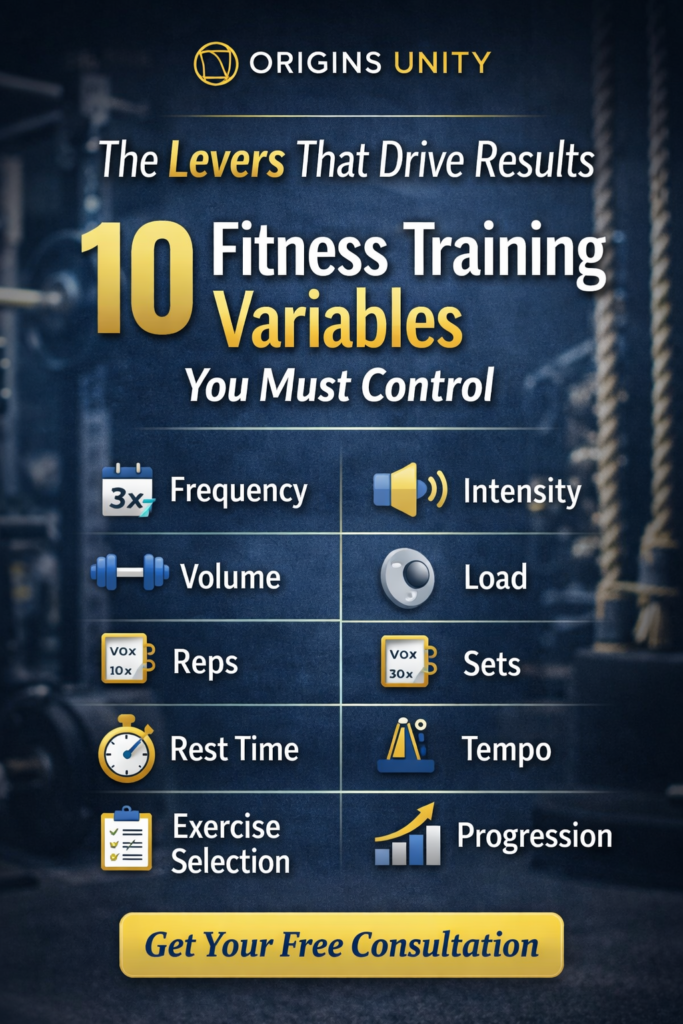
Once frequency, intensity, and progression are dialed in, these are the levers we start adjusting with more precision.
Volume is the total work performed across a session or week. Load is the resistance or weight used. Reps are how many times a movement is repeated. Sets are how many rounds of a movement are completed. Rest time is the recovery between efforts, where shorter rest builds conditioning and longer rest supports strength. Tempo is the speed of a movement, where slower builds control and faster builds power. Exercise selection is the specific movements chosen, and why.
None of these really work in isolation. A good program isn’t about picking the “best” one. It’s about how they play off each other.
The Advanced Training Variables
These are the adjustments a coach makes quietly, in the background, that most people never think to look for.
Range of motion is how far a joint moves through an exercise. Training density is how much work happens in a set amount of time. Session duration is the total length of a workout. Movement speed is how explosively a movement is performed. Exercise order is the sequence movements are placed in. Training modality is whether the focus is strength, cardio, or mobility. Energy system focus is aerobic versus anaerobic demand. Complexity is the skill and coordination a movement requires. Periodization is how the training structure shifts over weeks and months. Recovery strategy covers sleep, mobility, and stress management.
Why Workout Plans Stop Working
Most plans aren’t really built. They’re borrowed. Bits and pieces get pulled from what worked for someone else, without much thought about whether it fits your body, your schedule, or how much recovery you actually have to work with.
Without something adjusting these variables over time, progress tends to stall out. It’s rarely a discipline problem. More often it’s just a plan that never changes.
How Origins Unity Approaches Training Variables

We don’t believe in one perfect workout. There isn’t one.
We believe your body is telling you something, through energy, recovery, performance, and that information should shape the plan, not the other way around.
If progress stalls, we look at load or intensity before we look at effort. If recovery is lagging, we adjust volume or frequency before piling on more. If something isn’t working, we change the variable. Not the person.
Where to Start
You don’t need to master every variable on day one. Start with what’s actually sustainable.
Show up consistently. Train with real effort. Let progress happen gradually, not all at once.
The rest is precision, and that’s the part we handle.
Frequently Asked Questions
What are fitness training variables?
They’re the adjustable parts of a workout program, including frequency, intensity, volume, load, and recovery, that determine how the body adapts over time.
What are the most important training variables for beginners?
Frequency, intensity, and progressive overload. Everything else builds on top of these three.
Why do workouts stop working over time?
Usually because the program stays the same while the body adapts and needs something new. Adjusting load, volume, or rest time tends to help more than just pushing harder.
How many training variables are there?
Three foundational ones, seven core variables coaches adjust regularly, and around ten more advanced variables for detailed programming.
The Short Version
Fitness isn’t really about doing more. It’s about doing the right things, in the right amount, at the right time for your body.
That’s the difference between training and guessing.
Curious How This Applies to You?
Everybody responds a little differently to the same program. If you want a clearer picture of what yours could look like, we’d be glad to talk it through.
What has your experience been with training plateaus? We’d love to hear what you’ve noticed.